Jensen Huang is back at Nvidia, just 11 days after resigning. By midmorning following the announcement, the stock had jumped more than 30%, adding roughly $900 billion in market value and putting it on pace for a record one-day dollar gain.
That is a ridiculous amount of money moving around one person. But the interesting part goes beyond the stock price.
Nvidia supplies chips used to run Claude, and Anthropic’s public debut landed right in the middle of the chaos. The whole situation raises questions about founder dependence, government influence over AI infrastructure, and how much any business should rely on one provider.
The two lessons I would steal are simple: don’t build your business around one vendor, and don’t make yourself the person everything depends on.
Key Takeaways
- Founder dependence can leave a company vulnerable even when demand for its products remains strong.
- Claude’s usage limits depend on available compute, not simply changes in Nvidia’s leadership.
- Test your most important AI workflow with a second model before you need an alternative.
- Document responsibilities, access, and file locations so your business can function without you.
The 11 Days That Turned Nvidia Upside Down
The story began in late October, when The New York Times reported that U.S. officials believed a woman associated with a company buying Nvidia chips had connections to Chinese intelligence. China rejected that allegation as groundless speculation, and no charges had been reported.
Huang subsequently acknowledged an affair. The Financial Times reported that it involved the same woman. On November 12, he resigned, and Nvidia’s chief financial officer, Colette Kress, became interim CEO.
President Trump initially floated Apple’s Tim Cook as a replacement. Meanwhile, nearly 200,000 people signed a petition calling for Huang’s return, with Elon Musk among the supporters.
Then the situation got even stranger.
- November 17: Nvidia reported $115.8 billion in quarterly revenue, more than double its revenue a year earlier. On the same earnings call, the board chair said there were no plans to reinstate Huang, while the interim CEO did not mention him by name.
- The following Friday: Reuters reported that the SEC was examining possible accounting issues at Nvidia. The stock fell about 14%, completing seven consecutive weeks of losses and a roughly $2.6 trillion decline in market value.
- Over the weekend: Trump publicly called for Nvidia’s board to rehire Huang.
- The return: The board voted unanimously to bring him back, saying it had received input from senior U.S. government officials and that his return posed no national security risk.
Wall Street analyst Dan Ives had said he saw no chance of Huang returning. He had also estimated that Huang accounted for roughly $1 trillion of Nvidia’s valuation.
Wrong about the comeback. Pretty close on the price tag.
And then there is the Denny’s subplot. The restaurant where Nvidia was founded reportedly removed its commemorative plaque when Huang resigned, only to put it back the next day. Technically, Denny’s reinstated Jensen before Nvidia did.
What This Means for Nvidia: Founder Risk Is Real
The most revealing detail is not the comeback itself. It is the disconnect between Nvidia’s operating results and its stock.
Revenue more than doubled, yet the shares kept falling. My read is that investors were worried about who would run the company, not simply whether customers still wanted AI chips.
Tech analyst Ben Thompson’s description of Nvidia gets at the underlying issue: the organization was built around Huang. He had dozens of direct reports and no obvious second-in-command.
That structure makes a founder incredibly influential. It also makes the business vulnerable when the founder suddenly disappears.
An Interactive Brokers strategist suggested Huang had, in some respects, become too important to remove. That is a very different situation from replacing a CEO in an organization with a clear succession plan and distributed decision-making.
We saw a related example in November 2023, when OpenAI fired Sam Altman and brought him back within five days. Apparently, November is the month tech companies like to test everyone’s nerves.
A comeback does not resolve every problem
I would not treat Huang’s return as the end of the story. At the time of the announcement, several issues remained unresolved:
- An independent investigation was still underway.
- The reported SEC accounting questions remained open.
- Congress wanted answers from Huang.
- Senator Elizabeth Warren had criticized the reinstatement as reckless.
Even after the sharp rebound, Nvidia’s stock remained well below its October record.
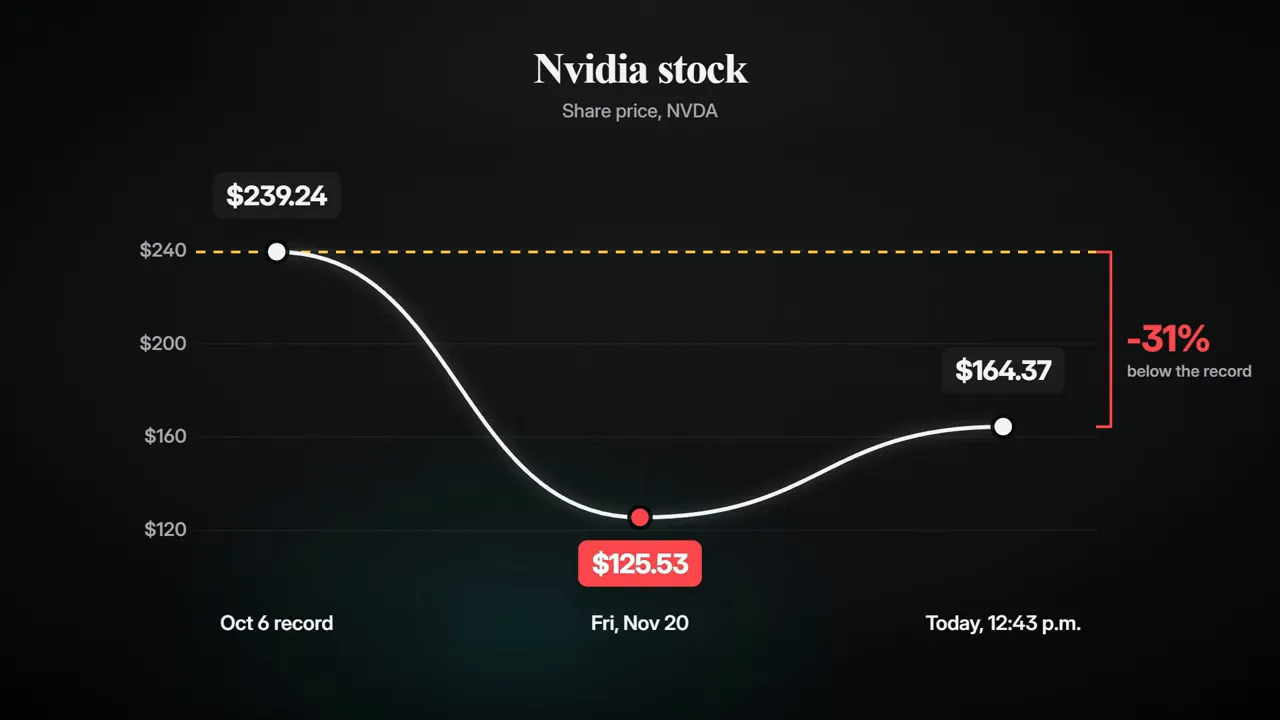
A rally can restore market value without resolving the governance questions that helped erase it.
What This Means for AI: Chips Are Becoming National Infrastructure
Two bigger themes stand out.
First, Washington now has a meaningful role in the leadership conversation at a major AI chip company. The board’s reference to input from senior government officials makes that hard to miss.
AI chips are increasingly being treated like strategic infrastructure, closer to oil or defense than an ordinary technology product. The question of who runs a chip supplier is becoming entangled with questions of national security.
Second, Nvidia is functioning almost like an AI index. When it fell, businesses tied to the AI trade fell with it. When Huang’s return sent Nvidia higher, the broader sector rallied too.
That does not mean every AI business has the same fundamentals. It means the market is treating Nvidia as a signal for confidence in the entire category.
What This Means for Anthropic and Claude
Anthropic, the company behind Claude, went public on November 19, right in the middle of the leadership turmoil. Nvidia was connected to that debut in two ways: as a chip supplier and through an agreement to purchase about $10 billion of Anthropic stock alongside the IPO.
When AI-related stocks sold off that Friday, Anthropic closed down about 8%. At its intraday low, the shares came within five cents of the $83 IPO price.
But there is an important distinction here: the stock and the servers are not the same thing.
Claude’s compute spans hardware from Google, Amazon, AMD, and Nvidia. One supplier having a terrible month does not automatically mean Claude stops working.
That diversification matters much more to day-to-day reliability than a single dramatic trading session.
The China chip-policy disagreement is still there
Anthropic CEO Dario Amodei and Huang also disagree on a substantive policy question: access to advanced AI chips in China.
Amodei has pushed for tighter restrictions. Huang has argued that export bans do not work.
You could argue that the allegations surrounding the resignation strengthen the case for restrictions. But Trump’s public praise of Huang following his return also signals political support for Nvidia’s founder.
I do not think that policy fight is close to finished. A leadership reversal does not settle the underlying disagreement about AI competition, chip access, and national security.
Will Claude Prices or Usage Limits Change?
For most people using Claude or ChatGPT, I would not expect an immediate subscription-price change because of this news.
Usage limits are more directly connected to compute capacity. Anthropic said in its IPO filing that demand was continuing to outstrip the capacity it had arranged, forcing it to buy additional short-term compute at a higher cost.
Huang returning to Nvidia does not instantly create more available processing power.
So, no, I would not expect suddenly generous Claude limits just because Jensen is back. The useful response is to make your own workflows more resilient.
Two Business Lessons Worth Stealing
1. Don’t depend on a single AI vendor
Anthropic spreads its infrastructure across multiple hardware providers. Apply the same principle to the AI models you use in your business.
This week, pick your most important workflow and run it through a second model.
The test is straightforward:
- Identify the AI-supported workflow your business depends on most.
- Run that same task through another provider’s model.
- Check whether the result is good enough for the workflow to keep functioning.
The point is not to collect subscriptions for the sake of it. It is to know that you have an alternative before you need one.
I keep subscriptions to most of the major AI providers because their relative strengths change. New models arrive, capabilities improve, and some weeks one tool is simply better suited to the work than another.
I do not want the business to become dependent on just one.
2. Don’t make yourself your company’s single point of failure
If you own a business, ask yourself a slightly uncomfortable question:
If I disappeared for two weeks, what would break?
Where do decisions stop? Which responsibilities are unclear without you? What information exists only in your head?
A practical starting point is to have Claude interview you and turn your answers into a one-page “if I’m gone” document. Keep it focused on the basics:
- Where login information is managed.
- Who owns each responsibility.
- Where important files are stored.
I use the free grill-me skill for this kind of structured interview. It helps pull out the information you might otherwise forget to document.
But the document is only the beginning. The bigger goal is to build an organization where everything does not have to flow through you.
Being essential can feel good. Being the bottleneck is not the same thing as building a durable business.
Don’t Make Money Moves From One Headline
There is also a useful reminder here for anyone holding AI stocks: confidence is not certainty.
One of Nvidia’s biggest supporters on Wall Street said Huang had no chance of returning. Days later, he was back.
I am not a financial adviser, and none of this is financial advice. But I would be careful about making investment decisions based on a single headline or one very confident prediction.
My Two Predictions
First, I think Nvidia will name a clear number two within a year. No board wants to go through this kind of leadership chaos twice, and the absence of an obvious successor has become impossible to ignore.
Second, somebody at that Denny’s is going to bolt the plaque to the wall.
The practical takeaway is less dramatic than either prediction: test a second model for your most important workflow, document what your team needs without you, and stop building systems that only work when one person or one provider is available.


