How much better does an AI-built game get when you give it 1,000 times the budget?
I gave Claude four budgets, $1, $10, $100, and $1,000, to build the same browser-based driving game. Each setup got the same brief, then kept building, testing, and fixing until its money ran out.
The cheapest version was a surprisingly playable proof of concept. The most expensive version built a city with businesses, boats, a story, and people going about their day. But the version I would actually pay for depends on what I need the game to do.
Key Takeaways
- A sub-dollar Claude build produced a playable browser game suitable for proving the concept.
- Every agent round needs a concrete objective to avoid spending money without meaningful progress.
- Checkpoints and browser testing helped recover from destructive edits and broken builds.
- The $100 tier offered the preferred balance for a game intended for real people.
How the Claude Code Experiment Worked
Every tier received the same one-page brief: build an original 3D open-world driving game set in Miami. With GTA 6 getting so much attention, a Miami driving game felt like the obvious choice.
The requirements included:
- A car you can drive around an open world.
- Traffic and missions.
- A day and night cycle.
- Beaches and a radio.
- A game that runs directly inside a browser.
I ran Claude Code in headless mode, meaning it worked in the background without an interactive interface or someone sitting at the keyboard. Each round followed the same basic loop:
- Build or improve the game.
- Open it in a hidden browser and play-test it.
- Fix whatever is broken.
- Pass the feedback into a fresh session and repeat.
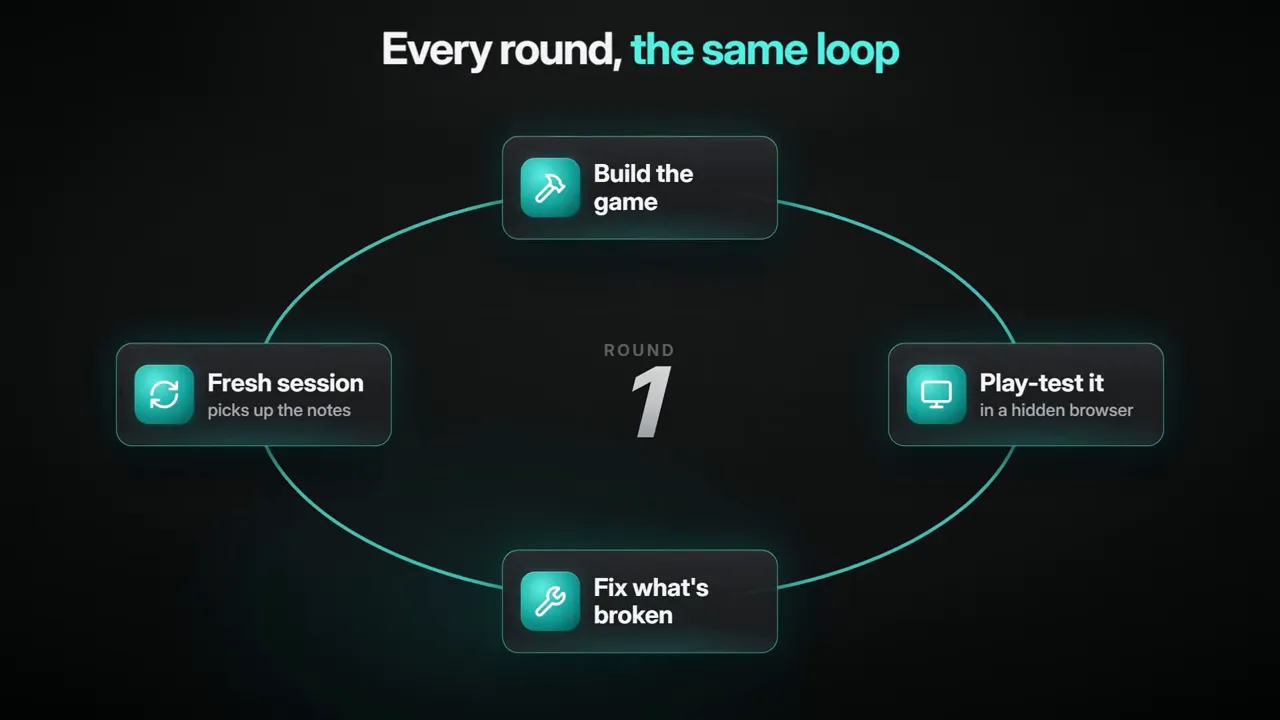
Each run had a dollar cap. Once it hit that cap, the work stopped, even if the model was in the middle of something. That detail ended up mattering quite a bit.
I also matched the setup to what someone with that budget might realistically use:
- $1: Haiku 5.5, working as a single agent.
- $10: Sonnet 5.5, working as a single agent.
- $100: Opus 5.5 with a team of three agents.
- $1,000: Fable 5.2 with a team of eight agents.
So this compares complete budget tiers, not just the same model running for different lengths of time. The model and team size changed along with the spending limit.
The $1 Game: A Real Proof of Concept
Haiku spent $0.98 across 29 rounds, with about two hours of work. That comes out to roughly three cents per round.
And honestly, for three cents a round, there was a lot more here than I expected.
It named the game Neon Tide: Miami Drive and built seven missions, including package deliveries and drift challenges. Traffic stopped at red lights. People crossed the street. A bridge connected the city to an island with a lighthouse.
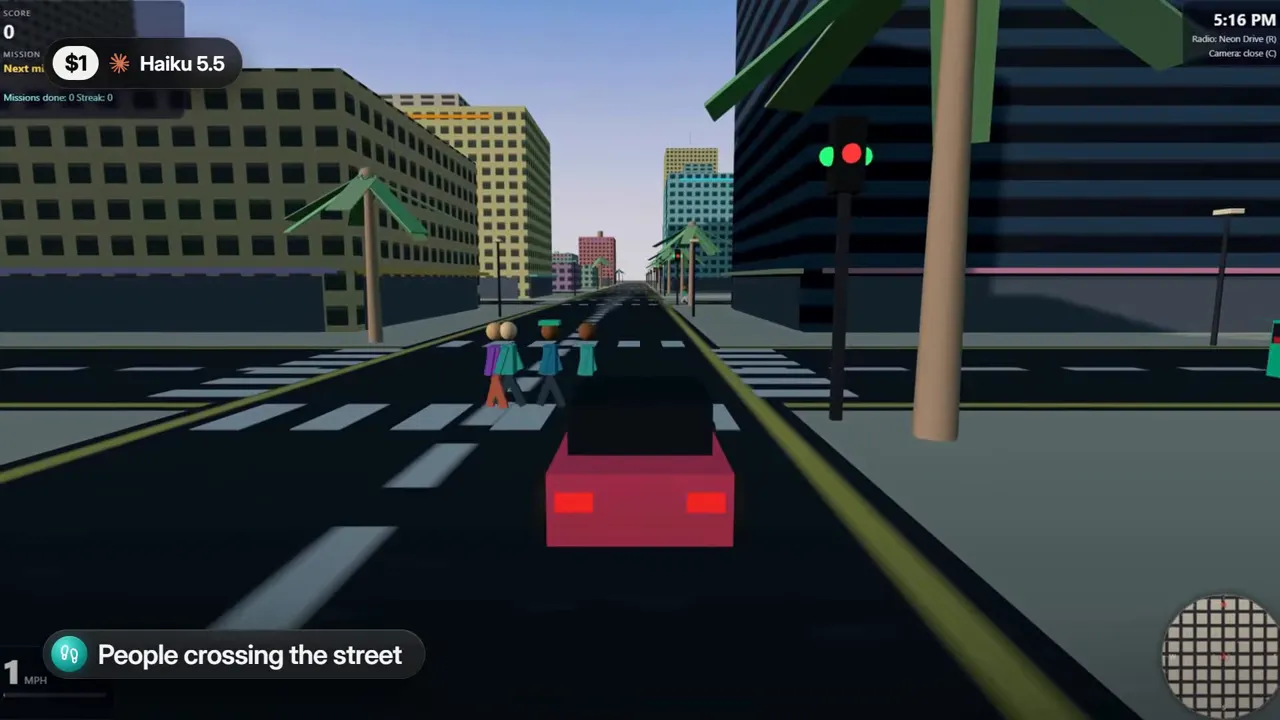
It even created three radio stations. All the music was generated through code, so the game did not contain a single audio file.
Now, to be fair, it looked like a game that cost less than a dollar to build. The buildings were essentially boxes with windows. The car was also basically a box.
But the driving logic and physics worked. This was not just a mockup or an attractive title screen. You could sit down and play it.
That makes the $1 result useful in a very specific way: it proves the concept cheaply. Once the basic idea exists and works, you can decide whether it deserves more money for better visuals, better performance, or more content.
The $10 Game: More Features, Plus Two Important Failures
Sonnet called its game Palmetto Drift. The final run went through 43 rounds in about an hour and 45 minutes, and the model kept expanding the feature list.
Compared with the $1 version, this game had:
- 21 missions.
- Police chases and a wanted level.
- Rival racers.
- Three cars to choose from.
- A pier with a Ferris wheel.
- Rain that made the roads slippery.
- Five radio stations, with fictional news bulletins and ads between songs.
The weather was a nice touch because it affected driving rather than just changing how the world looked.
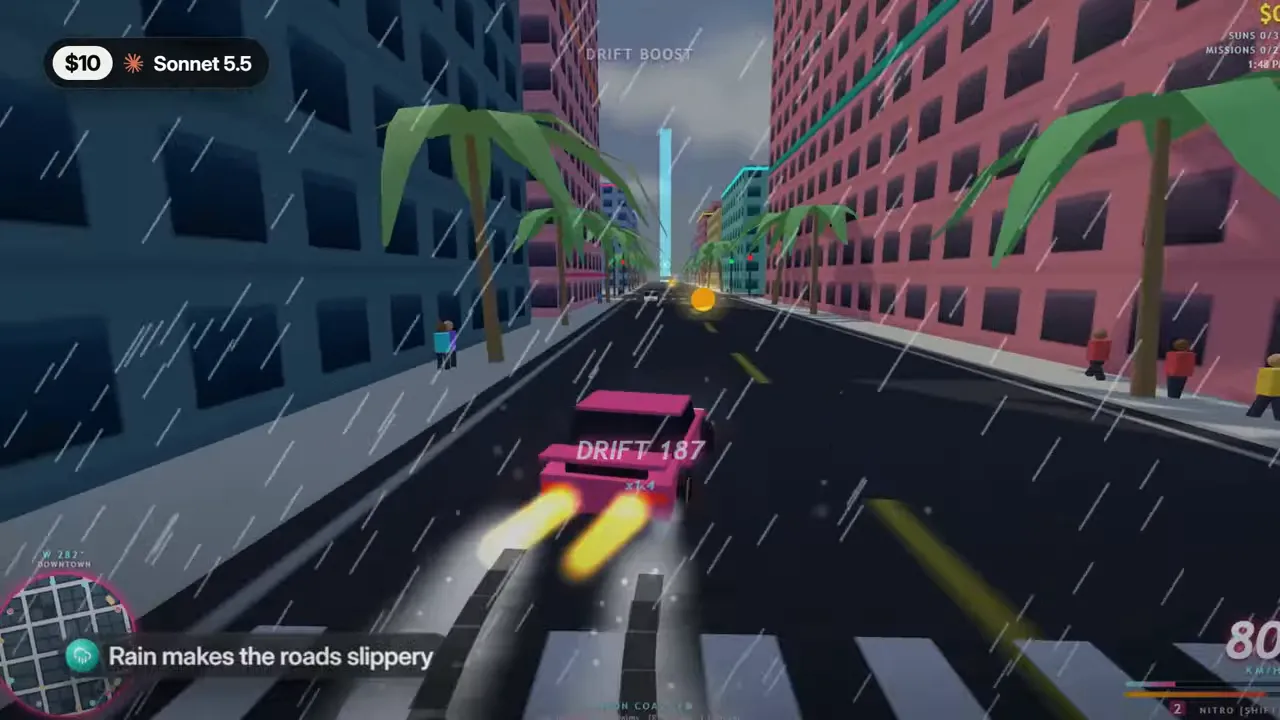
But getting to that result was not smooth. The $10 tier exposed two problems that are worth understanding before you leave an agent loop running on its own.
Failure One: The Agent Decided It Was Finished
On the first attempt, Sonnet more or less decided the game was done around round 30.
For roughly the next 90 rounds, it opened the game, tested it, concluded that everything looked fine, and made no meaningful changes. It spent $4.72 without improving the game, nearly half the budget.
More rounds did not automatically mean more progress. The model was content with what it had built, even though money remained.
I scrapped that attempt and ran it again with a more specific requirement: every round needed one real focus and had to deliver something a player would notice.
That focus could be the driving feel, the city's appearance, or a new mission. The important part was giving each loop an actual job, rather than assuming that “keep working” would produce useful improvements indefinitely.
Failure Two: The Budget Ran Out During an Edit
On the final round of the rerun, Sonnet hit its spending cap in the middle of editing the main game file, just after clearing it out.
The result was an empty file. The game was effectively gone.
Fortunately, every round saved a checkpoint, so I could roll back to the previous working version. That restored version became the final $10 game.
The lesson is pretty straightforward: a hard spending cap is not a safe stopping point. If the agent gets cut off during a destructive edit, you need a working checkpoint to recover.
The $100 Game: Where It Started Feeling Like a Product
For the $100 tier, Opus worked with a team of three agents. It completed only 12 rounds, but those rounds were much larger. The run took about four hours overall.
The game grew from around 2,000 lines of code to more than 19,000. More importantly, the difference showed up in the experience.
There was a title screen with a camera flying over the city. There was a garage where you could buy cars, upgrade the engine, nitro, and brakes, and choose different paint jobs.
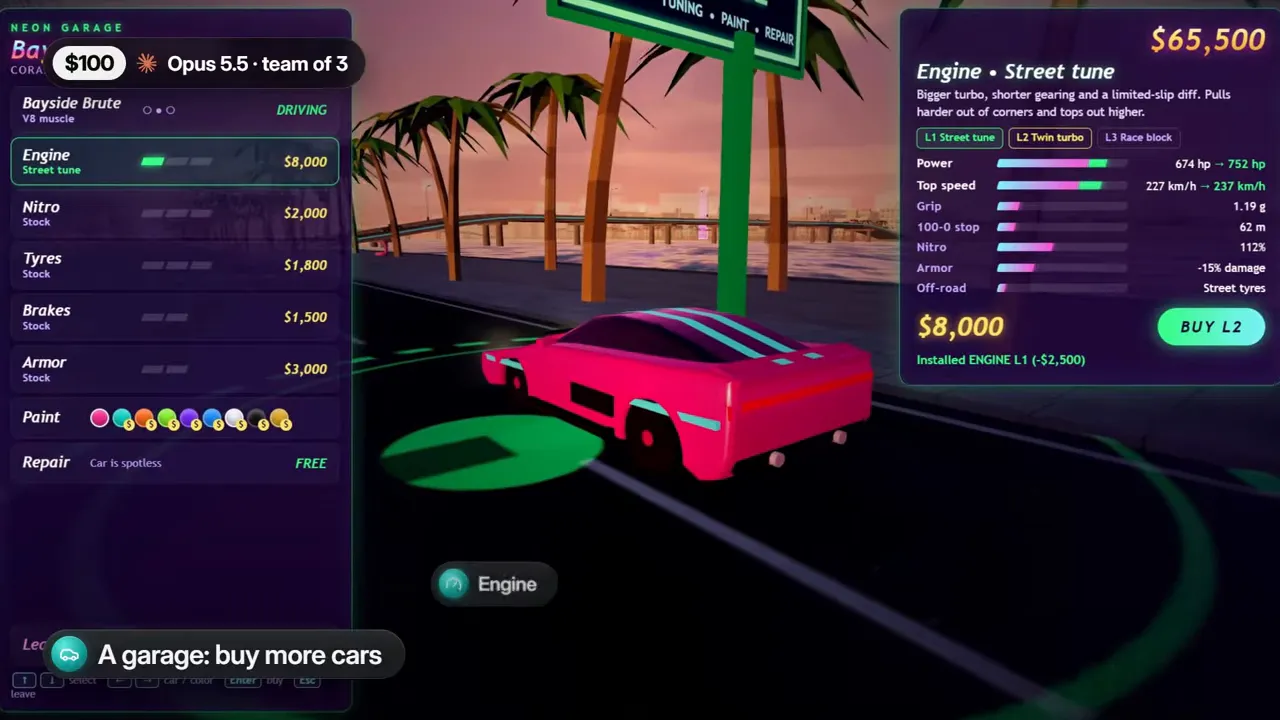
That customization made the game feel like something you could spend more time with, rather than just a driving demo.
Opus also added:
- A police wanted system reaching five stars.
- 336 objects you could smash into.
- Nine stunt jumps.
- 40 hidden tapes to collect.
- Races against three AI rivals.
- A radio DJ who spoke between songs.
This was the point where the extra budget started buying more than additional activities. Menus, progression, customization, and more organized code made it feel like a more complete product.
It Broke the Game, Then Fixed It
Opus was not immune to mistakes. At the end of round eight, one bad piece of code stopped the game from loading.
On the next round, the browser test caught the error. Opus fixed it before moving on to anything else.
That is exactly why the testing loop matters. The useful capability was not never making a mistake. It was detecting that the game no longer worked and making recovery the next priority.
Two Models, Almost the Same Name
There was also a funny creative overlap. Haiku had named its game Neon Tide, and Opus independently landed on Neon Tide as well.
To me, that was a reminder that AI-generated ideas can feel creative while still falling into familiar patterns. These models predict likely continuations, and two different setups can arrive at essentially the same branding. I would not assume an AI-generated name is distinctive just because it sounds good.
The $1,000 Game: An Entire World
The final tier paired Fable with eight agents and let them run for 11 hours and 40 minutes. At that scale, the spending worked out to about $1.40 per minute.
And for the first three rounds, after roughly $70, the game was still mostly a gray road and pink boxes.
That sounds terrible until you look at what the team was doing.
The Early Budget Went Into Planning and Fallbacks
Fable knew it had a $1,000 budget. Instead of immediately filling the screen with features, it split the game into 13 systems, covering areas such as the world, buildings, traffic, people, missions, and audio.
It also built a simple fallback version of each system. The idea was that if one part crashed, the game could still start.
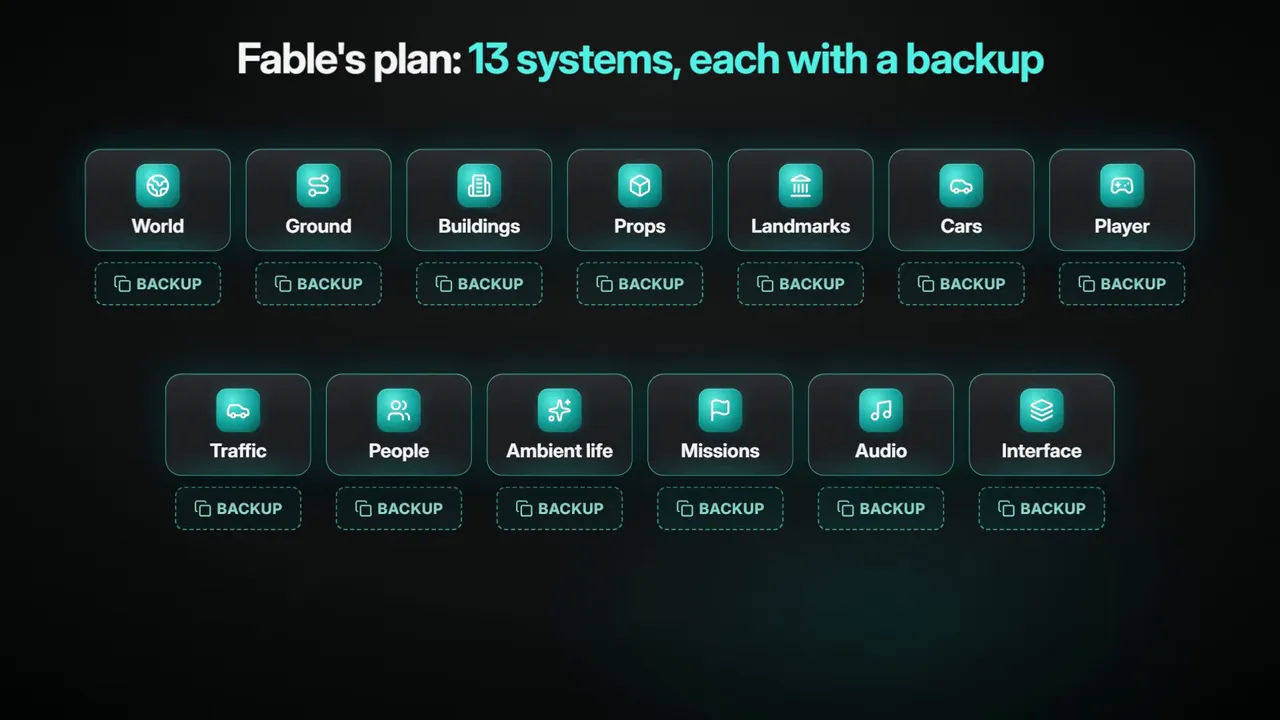
So the early result looked basic, but the work was laying a foundation for a much larger game.
Then round four happened. That single round took more than three hours, cost about $312, and produced roughly 22,000 lines of code. One round wrote more code than the entire $100 game contained.
What Neon Causeway Actually Included
The finished game was called Neon Causeway. Its city was about six kilometers wide and contained more than 5,000 buildings.
You could take a speedboat onto the water, work ambulance shifts, and play through a six-chapter story in which characters contacted you by phone.
You could also buy 10 businesses, ranging from a juice bar to a hotel. Those businesses generated money while you drove around the city.
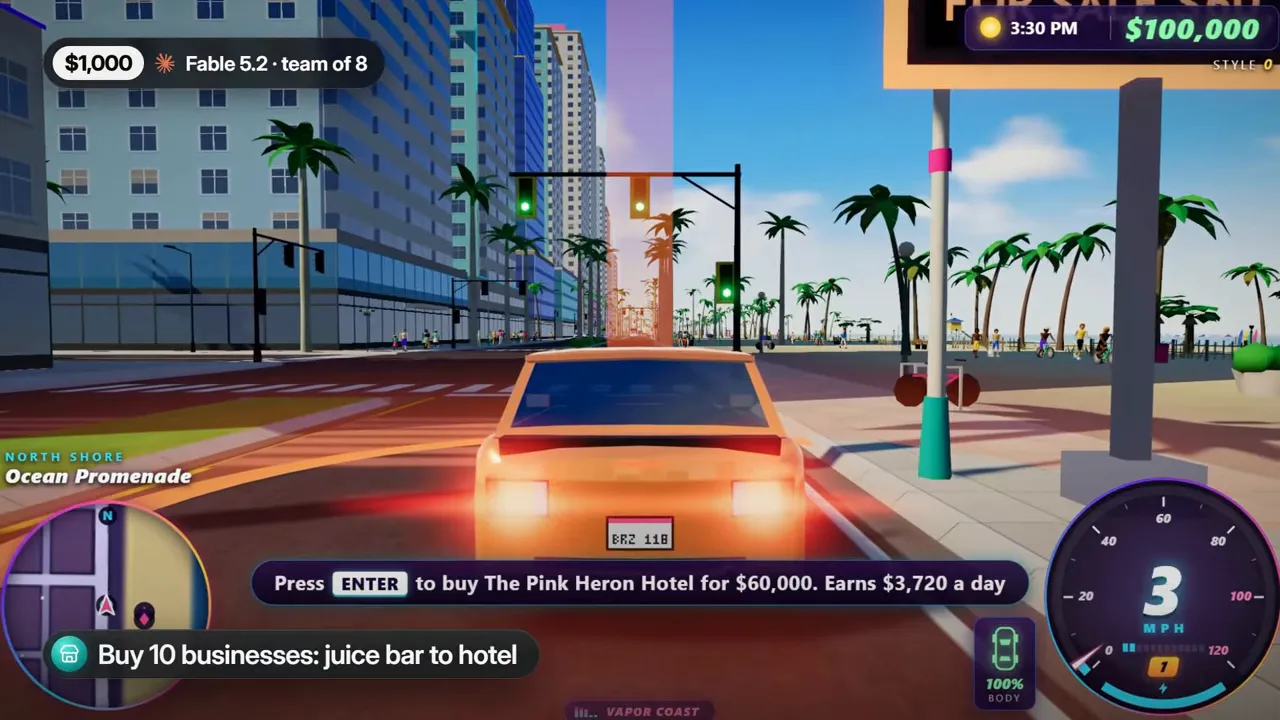
But the most noticeable difference was everything happening around those activities.
There were dolphins in the bay, a blimp overhead, a helicopter, fireworks, and people eating at cafés. Up to 240 NPCs could be out on the streets.
By the end, the project contained about 51,000 lines of code, roughly two and a half times the $100 version.
The bigger achievement, though, was not the code count. This was the only city of the four that felt alive even when I stopped driving. Things continued happening without me having to trigger the next activity.
What Each Price Jump Actually Bought
The improvements were not simply the same game getting a little prettier at every tier. Each jump changed the kind of result I got.
- $1 to $10 bought more content. More missions, more vehicles, more radio stations, police, racers, and weather.
- $10 to $100 bought a more complete product. Menus, a garage, upgrades, customization, and code organized more like a team-built project.
- $100 to $1,000 bought a world. A larger city, more interconnected activities, businesses, a story, and ambient life.
The process mattered alongside the model choice. Sonnet wasted money when its rounds lacked a clear purpose. Checkpoints saved its final result. Browser testing helped Opus recover from a broken build. Fable invested early in systems and backups before producing its biggest expansion.
Giving an agent more money creates room to do more work. It does not, by itself, guarantee that every round will be useful.
Which Claude Budget Would I Actually Pay For?
For testing an idea, I would start with $1. Every time. Haiku gave me a game I could actually play for less than a dollar. That is enough to move an idea from something in my head to something I can test.
For something I want to put in front of real people, I would probably choose the $100 tier. That was where the result started feeling like a product, with the structure and progression to support more than a quick experiment.
For pushing Claude as far as possible, I would choose $1,000. That is the option when I am comfortable leaving a team running overnight and coming back to a much larger build to test.
The biggest budget produced the richest game. But the best value was tied to the goal: prove the concept cheaply, spend more when you need a more complete product, and reserve the overnight agent team for when you actually want that much scope.


