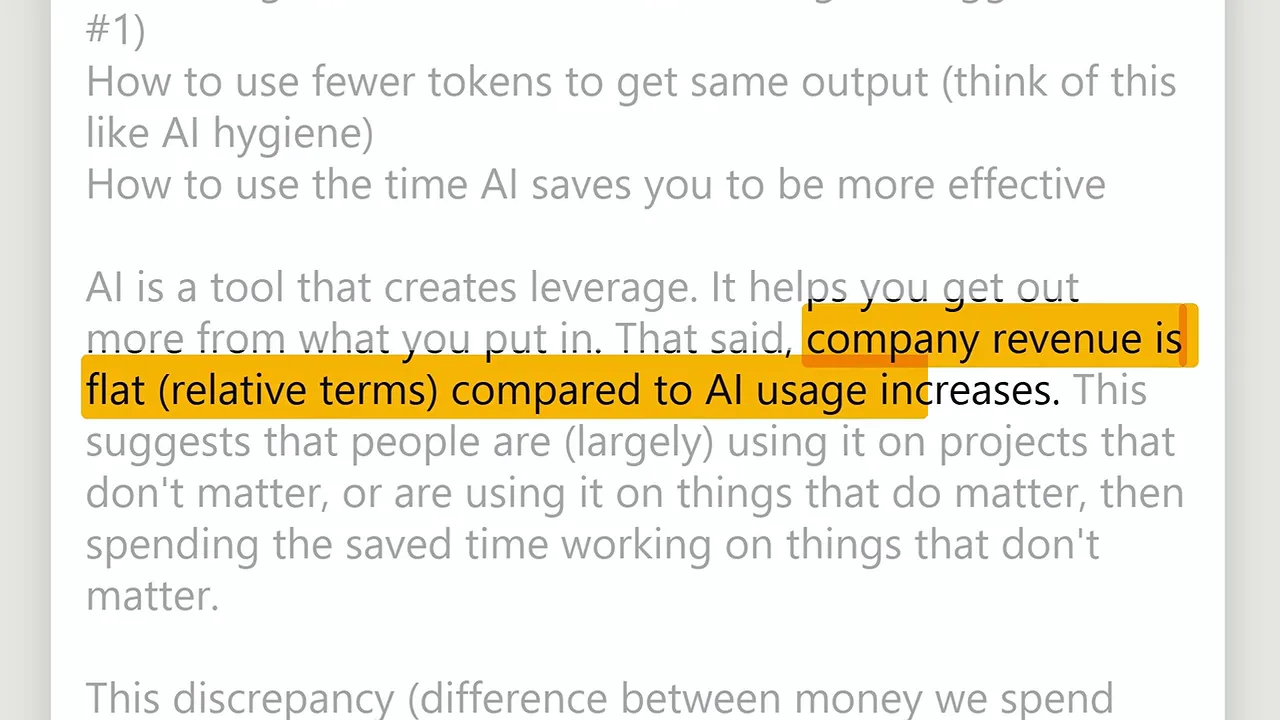
On September 30, Alex Hormozi told his team they would not be getting bigger AI budgets. His company was already spending roughly 16 times more on AI per employee than the average tech-forward company, while revenue had stayed relatively flat compared with the increase in AI usage.
That sounds surprising coming from someone who had previously made learning AI one of his strongest recommendations. But the two positions fit together pretty well: learn the tools, use them aggressively, and make sure the work actually matters.
I went through more than 200 of his videos and posts to understand how his team uses AI, the $350,000 automation mistake he warns about, and what he really says about replacing people. The useful part is how consistently he comes back to the same question: what business result did the AI actually improve?
Key Takeaways
- Aim AI at the business constraint and measure results rather than token usage.
- Break roles into specific workflows instead of trying to automate entire jobs at once.
- Build agents around your expertise while retaining responsibility for understanding and major decisions.
- Use AI’s time savings to build real experience, reputation, trust, and distribution.
Table of Contents
- Why Hormozi Capped His Team’s AI Budget
- How His Team Actually Uses AI
- AI Sales Agents: Text Is Working, Humans Still Lead on the Phone
- The $350,000 Automation Mistake
- What Hormozi Says About AI and Jobs
- Keep the Big Decisions for Yourself
- What AI Cannot Copy: Risk, Reputation, and Real Experience
- Use AI for Writing Without Flattening Your Voice
- Sell the Outcome Your Customer Wants
- Build Trust and Distribution With the Time You Save
Why Hormozi Capped His Team’s AI Budget
Hormozi is clearly serious about AI. He has said it takes up roughly half of his thinking about his business. His budget memo was a response to the gap between spending and results.
When token usage keeps climbing without a corresponding improvement in the business, something is off. His interpretation was that people were either applying AI to low-priority projects or using the time it saved to do more low-priority work.
Instead of approving more spending, he proposed training in three areas:
- Choosing worthwhile work: identifying which projects deserve attention in the first place.
- Using fewer tokens: getting comparable output with less AI consumption.
- Using saved time effectively: putting the extra capacity toward work that improves the business.
That last point is easy to miss. Finishing an unimportant task faster does not automatically create value. Neither does filling the freed-up time with another unimportant task.
And the providers have no reason to solve that prioritization problem for you. Anthropic and OpenAI charge for usage whether the thing you built ends up being useful or not.
How His Team Actually Uses AI
The budget freeze makes more sense alongside the workflows that are already working. Hormozi’s examples are specific: customer support, media production, writing assistance, and finding content ideas inside real business activity.
Customer support: five agents handling launch demand
For a book launch, his team deployed five AI agents to handle approximately 120,000 support tickets. He reported that about 90% were resolved without human intervention.
A lot of those requests were straightforward questions about where people could access their free materials. That context matters. This was a large volume of repetitive demand with relatively clear answers, which makes it a much more useful example than a vague claim that AI can run an entire support department.
Media production: break the role into workflows
Hormozi also reported that his media output tripled over a month without an increase in headcount. Prompts were taking on meaningful portions of the workload, allowing the existing team to produce more.
His way of thinking about this applies to almost any role. Rather than starting with the job title, examine the tasks that create the finished result.
For an editor, that means asking what specific activities turn raw footage into a finished piece, then treating each activity as a potential workflow.
His Hormozi Hotline clipping process is a good example:
- Read the text of the conversation.
- Identify the moments with the most tension.
- Start clips at those moments.
- Remove filler words and tighten the edit.

That is pretty close to how parts of my own editing work now. I record, hand the footage to Claude, and use it to cut retakes and dead air. I am building those editing pipelines over time, one piece at a time.
You do not need to automate an entire job before a workflow becomes useful. Taking repetitive steps off someone’s plate can already create a lot of capacity.
Writing: faster iteration while keeping authorship
Hormozi says writing tweets used to take him around 90 minutes a day. With AI assistance, that became roughly 90 minutes a week, which he describes as a sevenfold efficiency gain.
He is very clear about what changed: AI helps him generate ideas that he can iterate on. He still does the work of deciding which ideas are good and shaping the finished writing.
That distinction is useful for anyone creating content. Idea generation, refinement, and authorship do not have to be handed over together.
Content ideas from real meetings
His team also records meetings and turns them into searchable text. AI reviews those records alongside his calendar to identify interesting situations, decisions, and lessons from the week.
That gives him actual experiences to talk about. Instead of inventing a business story, he can explain a decision he made or a problem his team just worked through.
If your calls are already recorded, you already have much of the raw material for this workflow. The useful output is a shortlist of real moments worth discussing, with enough source context to find and verify them.
AI Sales Agents: Text Is Working, Humans Still Lead on the Phone
Sales is particularly interesting because Hormozi has made predictions about it publicly, then shared updates as his team tested the technology.
- January 2025: he estimated that a capable AI appointment setter was about three months away.
- April: he said an AI sales development representative, or SDR, was matching his human team.
- A later update: he clarified that his company was still hiring human SDRs because humans were outperforming its best AI in that role.
At the same time, he reported that a single AI text agent was selling around 200 units a month.
Those details belong together. His team had a productive text-based sales agent while humans were still winning on the phone, even after around two years of work on voice AI.
If you build AI systems for clients, that is a useful benchmark. Evaluate the actual channel and task. A successful text sales agent does not establish that a voice agent will deliver the same results, and an earlier broad statement about an AI SDR needs the context of the later clarification.
The $350,000 Automation Mistake
One of Hormozi’s clearest examples involves a business with 11 virtual assistants doing data-cleaning work. The team cost approximately $11,000 a month, did a good job, and had a process that worked.
The business then spent $350,000 trying to build an AI system to replace that work.
That was roughly three years of the existing team’s pay spent on automating a process that, according to Hormozi, was not even the business’s growth constraint.
The important question was where that money and attention could have made the biggest difference. Was the company short on leads? Was it struggling to convert sales? Could it reliably deliver what it sold?
This is closely related to the theory of constraints: focus improvement on the bottleneck limiting the overall system. Making another part of the business more efficient may leave that bottleneck untouched.
Ask whether the task should exist before automating it
Hormozi’s first filter is prioritization. Determining that something does not deserve to be done can save more effort than building a system to do it automatically.
That is exactly the mindset I encourage when working with clients. Adding AI to a business needs a clear purpose. You should be able to name the number you are trying to move.
A useful check is to ask:
- Since I started using AI, am I getting more content views?
- Am I generating more leads?
- Am I making more money?
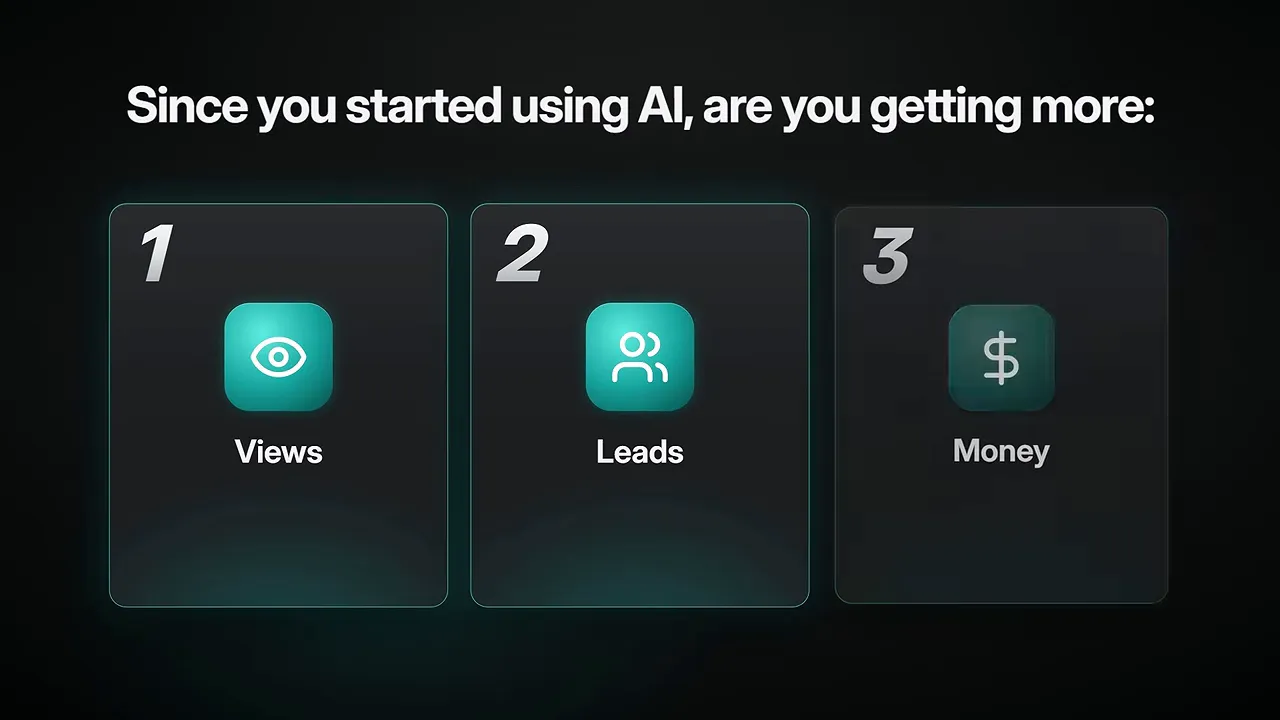
Choose the result that fits the work. If the token bill keeps increasing while the relevant result stays flat, revisit the constraint and point AI at that.
The career advice in his memo follows the same logic: demonstrate how much useful output you can get from a small amount of AI usage. Being the person who spends the most on tools is a weak case for value. Being able to explain the return on that spending is much stronger.
What Hormozi Says About AI and Jobs
I looked hard for a public example of Hormozi saying he had fired someone specifically because of AI. Across the material I reviewed, I could not find one.
That is a limited finding, not proof that no such staffing change has ever happened. What he does say publicly is that his company uses AI heavily across advertising and content while continuing to hire.
He also points to AI companies themselves employing thousands of people as a reminder that powerful AI and human hiring can coexist.
But his advice to other business owners is blunt: raise the performance standard across the company, and keep the people who can meet it.
In one onstage exchange, the owner of a $20 million website company said AI was hurting his business. Hormozi advised him to spend six months rebuilding workflows around AI and reduce headcount by half, suggesting that this could roughly double the company’s margin.
That was advice for that business, rather than an outcome he reported achieving himself. Still, it makes his position pretty clear: continued hiring does not mean the expectations for each employee stay the same.
Bring your own agent
For the person on the team, his recommendation is to develop the capability first. He describes a future of bringing your own software or your own agent.
The idea is to train agents on parts of the work you already know how to do. You become someone who can manage a larger scope of work because you have built systems around your expertise.
Instead of competing only on how many tasks you can complete manually, you can demonstrate what you and your tools can deliver together.
That lines up with what I found in a survey of more than 1,000 people in my community. Among respondents who had repeatedly used AI to solve a real problem at work, 70% reported a meaningful career change, such as a new role, new clients, or a substantial raise.
That is a result from a community survey, not a guarantee. But it supports a practical direction: repeatedly solving real problems is a better place to focus than collecting tools.
Start with four hours a week and one specific task
Hormozi’s starting recommendation is manageable: block off four hours each week and use that time to automate or improve one task you already do.
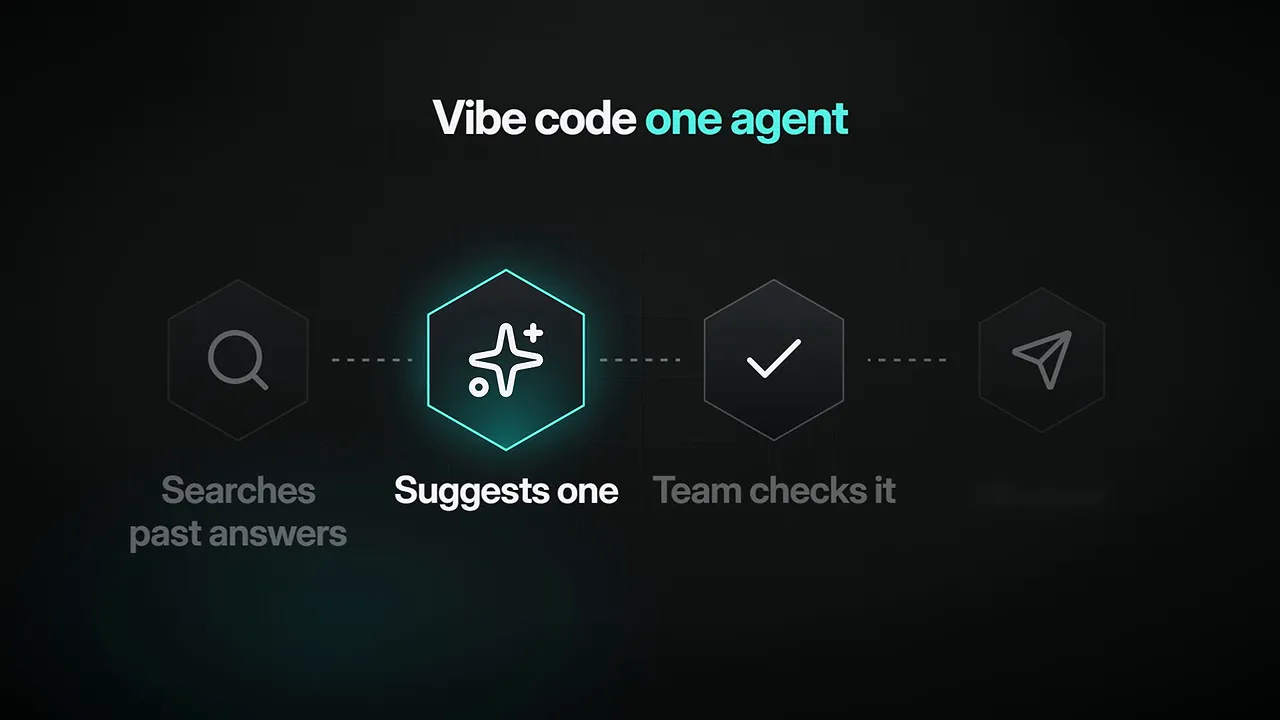
Tina’s business is a good example. She was running cohort programs through Telegram, and her team kept answering the same questions. Hormozi suggested building an agent that would:
- Search previous answers.
- Suggest a relevant response.
- Let the team review it.
- Send it after approval.
A couple of months later, she reported that she had built the dashboard, moved her team’s work out of Telegram, and created nine additional tools for her business.
The starting point was a recurring problem her team understood well. Solving that gave her a foundation for building more.
Keep the Big Decisions for Yourself
There is one category Hormozi is much less comfortable delegating: major decisions.
He describes periodically testing different AI systems with what he considers an obvious decision and getting widely different recommendations. For him, that is a reason to retain responsibility for judgment.
His operating rule is to delegate the typing while keeping the thinking. My own version, which is not an original quote, is that you can get help with thinking, but you should never outsource your understanding.
Either way, the responsibility stays with you. If you cannot explain why a recommendation makes sense, you are not ready to own the decision it produces.
That boundary matters more as AI gets better at producing confident, polished answers. The quality of the presentation does not remove your obligation to understand the choice.
What AI Cannot Copy: Risk, Reputation, and Real Experience
Hormozi’s longer-term argument is that as labor and intelligence become cheaper, human value shifts toward taking risk and owning outcomes.
AI can generate recommendations. Someone still has to commit the money, pay for the tools, own the business, and live with the result.
Real stakes create value
He uses MrBeast as an example. A production involving a real $5 million prize or a real Lamborghini has stakes. Generating an artificial version of those things changes what the experience means, because the underlying commitment is missing.
His point is that people care about what actually happened and what someone genuinely put on the line.
Experience gives the same advice different weight
Imagine two people publishing the same six tips for scaling a sales team. One generated the advice with ChatGPT. The other has built 10 real sales teams.
Hormozi argues that the second person has the advantage because the advice comes with lived experience and a reputation attached to it.
That is what he means when he treats reality as a competitive moat. Your track record, brand, and reputation develop through things you actually do. AI can help communicate that proof, but the proof has to exist.
Use AI for Writing Without Flattening Your Voice
Hormozi has very little patience for generic AI writing. He specifically criticizes forced contrasts, repetitive negation, and choppy sentences that make every point sound artificially dramatic.
I keep a list of those kinds of phrases out of my own scripts and content too. They tend to make different people sound exactly the same.
His recommendation is to give the model concrete guidance: something like 12 rules it must follow and 16 examples of your own writing. He estimates that this can make the output about five times better.
Treat that as his assessment rather than a measured benchmark. The practical lesson is straightforward: a model has a better chance of matching your voice when you show it what that voice sounds like and define what it should avoid.
That fits his broader writing workflow. Use AI to help generate and refine ideas while staying involved enough to preserve your judgment and authorship.
Sell the Outcome Your Customer Wants
Hormozi is equally direct about AI businesses: building a tool does not, by itself, give you a compelling offer.
Customers still want familiar outcomes. They want things to be faster and easier. They want to lose weight, improve a relationship, or solve whatever problem brought them to you.
The technical mechanism may matter to delivery, but it is rarely the clearest starting point for the offer. Explain the result the customer wants in language they already understand.
For an AI automation agency, that means staying grounded in the client’s business problem. The same question applies before the build and during the sale: what useful outcome are we creating?
Build Trust and Distribution With the Time You Save
When Steven Bartlett asked what he would do if superintelligence were only a few years away, Hormozi’s business answer was to keep building trust and distribution.
His personal answer was to think seriously about what it means to be human, why he is here, and love. That is a different kind of answer from another productivity recommendation, and it is worth keeping alongside the business advice.
The overall approach is practical:
- Use AI broadly where it can do useful work.
- Focus it on the constraint holding the business back.
- Build workflows around your own role before someone else does.
- Keep responsibility for major decisions.
- Use the saved time to build real experience, proof, trust, and reach.
You can be extremely optimistic about AI and still be disciplined about spending, skeptical of weak outputs, and protective of your judgment. That combination is what makes Hormozi’s approach useful.
I put the meeting-to-content prompt and a guide to the Hormozi sources, including links and timestamps, inside my free AI Automation Society community.
|