Companies are buying AI faster than they can make it work. That gap is creating a big opportunity for people who can walk into a business, figure out what is actually broken, and build something that fixes it.
The role is called a forward deployed engineer, or FDE. And it is not just for software engineers. Consultants, analysts, former founders, and agency owners are moving into it too.
When I researched the market, OpenAI had a posting offering up to $325,000 in annual base salary, and FDE job postings had reportedly grown more than tenfold over the previous year. I also pulled roughly 200 unique roles across 24 AI companies to understand what employers were actually asking for.
The opportunity is real. But so is the work. Here is what the job involves, who it fits, and the five-step roadmap I would follow to get hired.
Key Takeaways
- Forward deployed engineers combine customer discovery with technical delivery to create measurable business outcomes.
- Focus your learning on whichever side is weaker: production engineering or customer-facing problem solving.
- Evaluations provide measurable evidence that an AI system works beyond a successful demo.
- Build one real customer project and document both results and adoption before applying.
What Does a Forward Deployed Engineer Actually Do?
The role started at Palantir. The easiest way to understand it is to think about what happens after a company buys a powerful AI product.
They pay for the platform. Then they realize they have no idea how to connect it to their CRM, internal data, old tools, and messy processes. Buying the software was the easy part.
That implementation gap helps explain why the widely cited MIT NANDA report on generative AI found so many initiatives failing to produce measurable returns. The statistic that got repeated everywhere was 95%. The practical point is that access to a model does not automatically create business value.
Instead of giving the customer a login and wishing them luck, the AI company sends an engineer to work alongside them. That person figures out what the customer needs and helps build the solution in production, on the customer’s infrastructure.
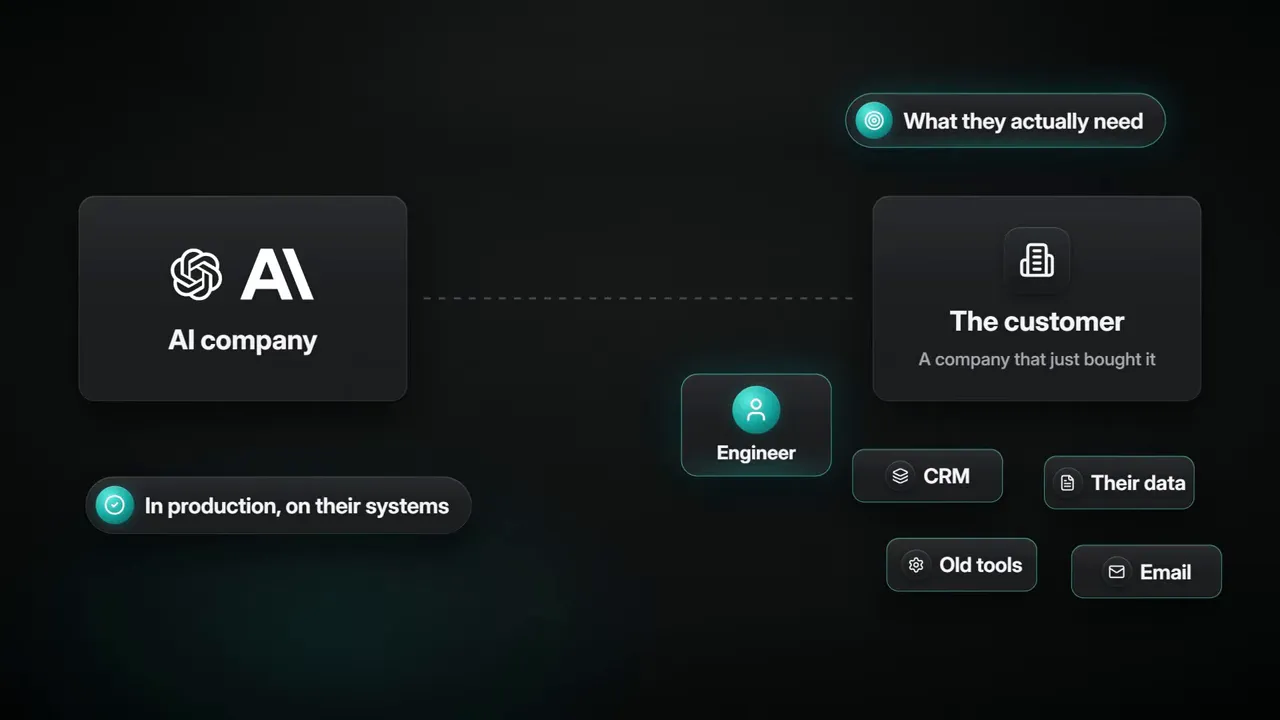
Kevin Bai, who worked at Palantir and later joined Anthropic’s Applied AI team, describes the role as customer-facing software engineering. The important distinction is that the customer is buying an outcome, not simply software access or someone’s time.
Anthropic’s FDE posting, for example, includes delivering technical artifacts such as MCP servers, subagents, and agent skills. These are concrete things that help the customer make the platform useful inside their business.
If you are already building AI automations or running an AI consultancy, some of this probably sounds familiar.
Why This Looks Familiar to AI Agency Owners
When I worked at Goldman Sachs as a business intelligence analyst, automation was basically my job. I wanted to become the AI person there, but there was too much red tape. Eventually, I left and built an AI automation agency.
Looking back, that agency, and later the consultancy we built, operated a lot like an FDE team for small businesses.
We would walk into a real estate agency or an HVAC company, and they would ask for something they had seen on LinkedIn or my channel. Our real job was figuring out whether that was actually what they needed.
Sometimes it was. Sometimes we needed to build something different. Either way, the responsibility was the same: make it work for that particular business.
What About the Salary?
Across the postings I collected, the typical base salary range was roughly $180,000 to $275,000. Median total compensation, including stock and bonuses, was around $230,000.
Those figures are a research snapshot, not a promise that every FDE opening pays that much. But the high compensation is not limited to one OpenAI listing.
Who Is This Job For?
Read an FDE job description literally, and it can sound like a company wants a senior engineer, a consultant, and a product manager in one person.
That is because the job combines building with discovery, communication, and delivery. Across the roughly 200 roles I reviewed:
- About 80% mentioned scoping or discovery.
- About 80% mentioned stakeholders, executives, communication, or change management.
- Roughly three quarters explicitly described customer-facing work.
- About 60% mentioned Python.
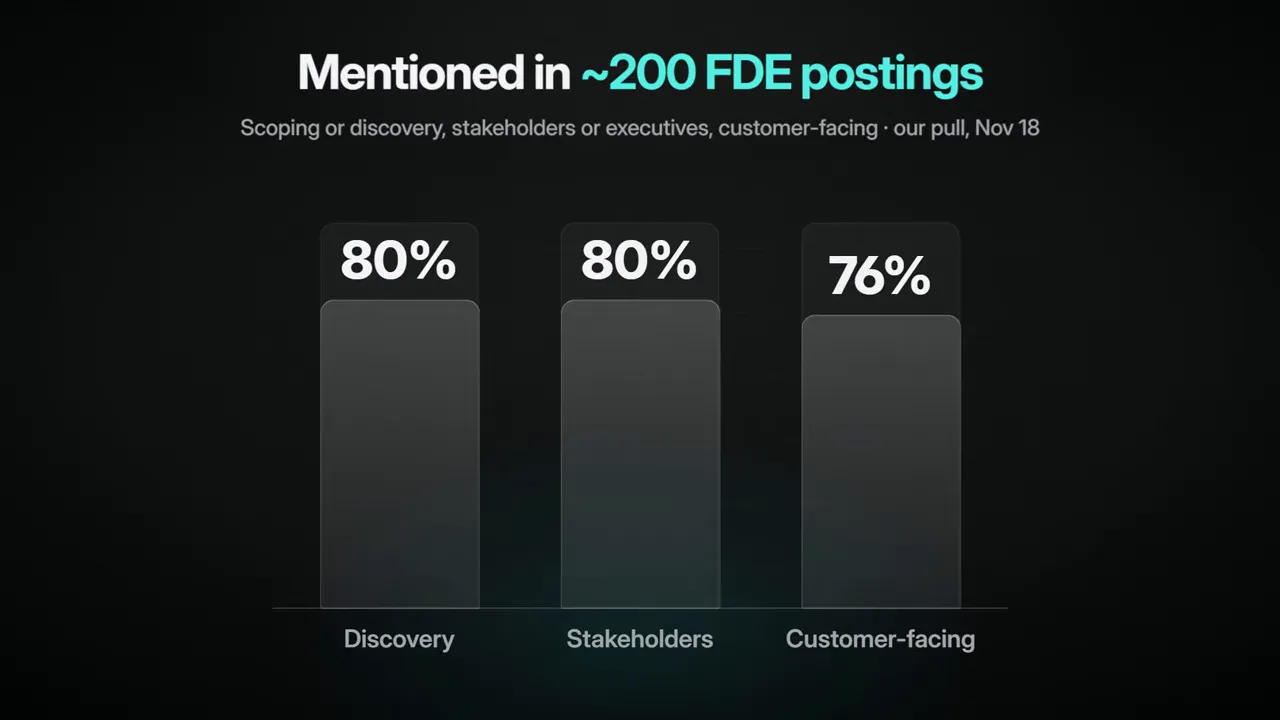
Code matters. But employers are not only looking for someone who can write code. They need someone who can understand a business problem, explain tradeoffs, earn trust, and then deliver the technical solution.
Tools like Claude Code and Codex make building more accessible. They do not remove your responsibility for whether the system works.
The Three Most Natural Starting Points
For most people, this looks more like a lateral move than an entry-level role. The most obvious paths are:
- A software engineer who likes people: You can build, and you want to work directly with customers.
- A consultant, analyst, or solutions engineer who learned to build: You understand business needs and can turn them into working systems.
- A technical founder, freelancer, or agency owner: You have already been doing much of this work without the FDE title.
Most postings asked for at least five years of experience. Only around one in ten asked for three years or less, while roughly one in five mentioned a degree. Anthropic explicitly encouraged former technical founders to apply.
If you do not have five years yet, that does not mean the broader opportunity is closed. I expect more smaller companies and businesses outside the AI industry to need this capability, even when the title is AI consultant rather than forward deployed engineer.
The Tradeoff: Travel and Ambiguity
About two thirds of the postings mentioned travel, commonly between 25% and 50% of your time. Colin Jarvis, who leads forward deployed engineering at OpenAI, has said new joiners should expect around half their time on site.
A recruiter quoted in The Pragmatic Engineer described a market where nearly everyone wants to hire these people, but only a small share of candidates want the job. That is useful context: high demand does not mean the lifestyle suits everyone.
If you enjoy building AI solutions, working with people, and dealing with a little chaos, it could be a strong fit. If you want clearly defined tickets and very little customer interaction, probably not.
Will the FDE Title Last?
It is a fair question. Prompt engineer was an incredibly hot title in 2023, and it became less distinctive as prompting spread into everyone’s work and models improved.
Forward deployed engineering is broader. It covers the whole process: find the real problem, build the solution, and prove it works. That combination is harder to reduce to one skill, even if the title changes.
A Typical Week as an FDE
Based on the postings and firsthand accounts I found, a week might look something like this:
- Monday: Discovery on site. Sit with the operations team and the people doing the work. Ask questions and understand the actual workflow.
- Tuesday: Scope the project. Define the problem, the metric you want to improve, and what counts as finished.
- Wednesday and Thursday: Build and test. Connect an agent to the customer’s CRM or data, write evaluations, and test against real inputs.
- Friday: Demonstrate and share feedback. Present the work to stakeholders, then tell your own product team where the model failed and what customers keep requesting.
Another important responsibility is turning successful deployments into reusable patterns. Anthropic specifically calls this out in its FDE posting.
I do a smaller version of this in my own business. I complete a task with Claude, then turn the useful process into a repeatable skill. An FDE does that across customer deployments and company workflows.
That does not mean everything should become an agent skill. Sometimes the better result is a more deterministic automation. The point is to avoid rebuilding the same solution from scratch every time.
A Production Consideration: Can the Customer Afford to Run It?
An automation can work perfectly in testing and still become a problem once it runs on a schedule or responds to every trigger. Every execution sends tokens to a model, and someone pays that bill.
Sponsored resource: Multiverse Computing’s CompactifAI API focuses on reducing those inference costs. In the pricing example provided, GLM 5.3 cost $0.20 per million input tokens and $0.64 per million output tokens.
For a monthly workload of 80 million input tokens and 20 million output tokens, that worked out to $28.80, compared with approximately $200 through the model maker’s own API in the comparison. Multiverse Computing’s optimized Qasar model brought the example to about $15.
The API is OpenAI-compatible, so supported workflows can switch providers by changing the base URL, API key, and model selection. Pricing and availability can change, but the underlying lesson is worth keeping: a production solution needs to be affordable to keep running, not just impressive in a demo.
Step 1: Find the Half You Are Missing
Before studying anything, be honest about which side you already have:
- Are you the builder?
- Or are you the person the customer trusts?
If you are an engineer, your biggest gap may be discovery, executive communication, and stakeholder management.
If you come from consulting, operations, or analytics, your gap may be building systems that hold up in production.
Spend most of your development time on the weaker half. Do not study everything equally just because it appears on a roadmap.
Step 2: Learn the Build Stack, Especially Evals
The technical requirements in the postings were fairly consistent:
- Python: Mentioned in about 60% of roles.
- TypeScript or JavaScript: Also appeared in roughly 60%.
- APIs and integrations: Around 60%, because connecting systems is central to the job.
- Agents: Around 60% mentioned them.
- Evaluations: Appeared in about half, although I think they belong in every posting.
When these companies say “agents,” they mean systems where a model decides what to do next, calls tools, and carries out multiple steps. That is different from simply using Claude Code to generate your application code.
Why I Would Go Deep on Evals
If I could pick one technical area to emphasize, it would be evaluations, or evals.
An FDE has to show the customer that a system works. A good demo is useful, but it does not establish reliable performance. Evals give you a formal, measurable way to test that performance.
Think about creating a Claude skill. The first version might get you 60% or 70% of the way to the result you want. You give feedback, refine the instructions, and eventually get much closer to your target.
Evals make that improvement process more structured and measurable, rather than relying on whether the latest output feels better.
I come from marketing and analytics, not a traditional engineering background. I know how much AI coding tools lower the barrier to building. But frontier labs still want strong engineers. You still need to get good, understand what you are delivering, and prove that your automations behave as intended.
This is an AI-assisted route into technical work, not a way to avoid technical competence.
Step 3: Practice the Customer Half
One of the cheapest ways to practice discovery is to have Claude play the customer. You can also arrange mock calls with other people learning this work.
Give Claude a scenario like this:
Play the VP of operations at a logistics company with 200 employees. Your company bought an AI platform three months ago, but the implementation is not working. I am the forward deployed engineer meeting you for the first time. Reveal information only when my questions uncover it. After 15 minutes, assess my discovery process and explain what I failed to investigate.
The exercise only helps if you have to earn the information. You want to practice uncovering the problem, not receiving a perfectly organized brief.
Write a One-Page Scope After Every Session
Keep it simple. Your scope should capture four things:
- The problem: Describe it in the customer’s own words.
- The metric: Name the one number the project should improve.
- The finish line: Explain what a completed, successful solution looks like.
- The boundaries: State what you will not build.
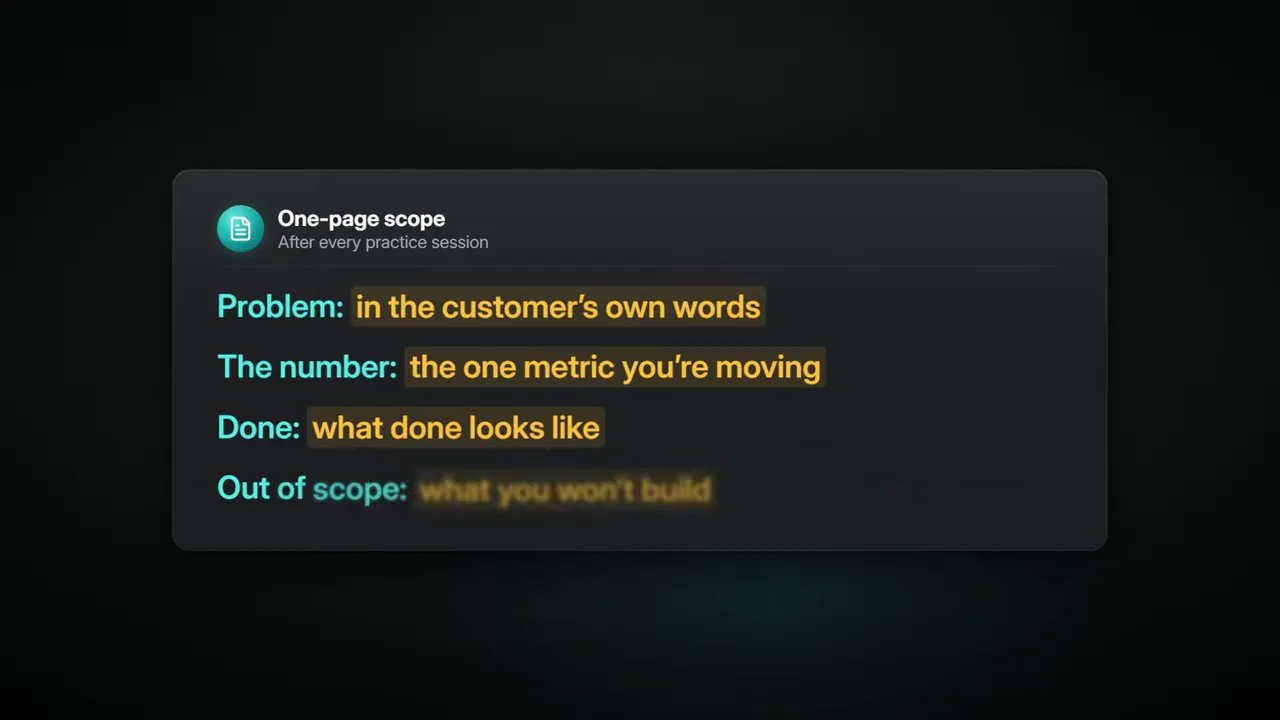
If you cannot identify the number you are trying to move, you probably do not have a well-defined project yet.
If you already have a job, volunteer for demos, onboarding calls, and requirements meetings. Those are practical opportunities to build the customer-facing skills that are easy to overlook when you focus only on tools.
Step 4: Build One Proof Project That Covers the Whole Process
One project can be enough to demonstrate the work, provided it is for a real customer and covers the full process. That customer could be your own team at work, a friend’s business, or a local company.
Do not stop when the automation runs once. Complete the sequence:
- Run discovery.
- Write the scope.
- Build the solution.
- Put evaluations around it.
- Demonstrate it to the stakeholders.
- Return two weeks later to measure results and find out whether people are actually using it.
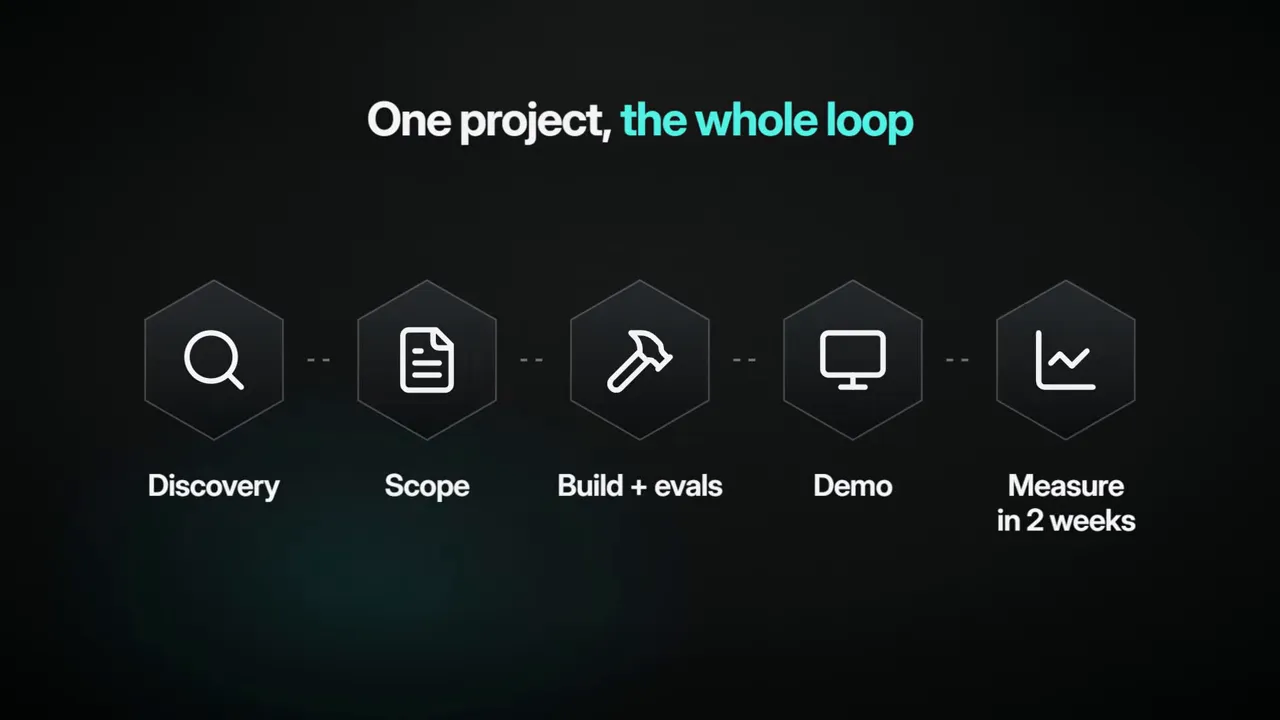
Then write a short case study with the before-and-after number.
That case study becomes the concrete evidence you bring into interviews. It gives you something much stronger to discuss than a list of tools: a real problem, a defined outcome, a working system, and evidence of what happened after deployment.
Step 5: Apply Beyond One Company or Job Title
Most of the companies I researched used Greenhouse, Ashby, or Lever for their postings. Going directly to company career pages is a good starting point.
Databricks, Palantir, and OpenAI had the largest numbers of open FDE roles in my sample. Other companies included:
- Scale AI
- Cursor
- Anthropic
- Cohere
- Cognition
- Smaller AI startups
Google Cloud also had relevant roles on its own careers site. Venture capital job boards from a16z, Accel, and General Catalyst are useful because they collect openings across portfolio companies.
Search for the Work, Not Just the Title
Use several search terms:
- Forward deployed engineer or FDE
- Forward deployed software engineer
- Deployed engineer
- Deployment strategist, which may be less technical
- AI consultant
- Founding FDE
Read the responsibilities, not just the job title. A role with a different name may still involve the same combination of discovery, building, deployment, and customer outcomes.
Smaller companies are worth considering because many are building these teams from zero. Kevin Bai, for example, was the first FDE at Rippling, where the team grew to around 25 people in a year.
Prepare for Business Cases and Engineering Rounds
Expect interviews to test whether you can turn an unclear business problem into a defensible technical strategy. Anthropic’s staff FDE posting explicitly describes that ability.
Start by asking what the business wants to improve before pitching a solution. Walk through your proof project as if the interviewer were the customer.
Also prepare for technical assessment. One engineer’s account of Google’s FDE interview process included coding, debugging existing code with AI tools, system design, and a behavioral interview. That is one reported experience, not a universal interview format, but it shows why AI-assisted building does not eliminate engineering expectations.
The Opportunity Is Becoming the Person Who Can Deliver
The gap I keep seeing is not a lack of AI budgets or access to models. It is a lack of people who can identify the real problem, understand the constraint, build something that runs in production, prove it works, and get the team to use it.
That is why we built the Certified AI Consultant program at AI Automation Society around that same process. It applies whether you want an FDE job or want to deliver this work through your own business.
If I were starting now, I would not begin by chasing every new AI tool. I would identify my weaker half, learn the practical build stack, practice discovery, and complete one real project with measurable results.
The title may evolve. The ability to make AI useful inside a real business is the skill I would focus on.


