Every time a new AI model launches, the same cycle kicks off. The demos go viral. Everyone calls it the best model ever. People switch from Codex to Claude Code, or right back again. Then, a week or two later, the complaints start: Why does this feel worse?
I went looking for evidence, and the answer is more interesting than a simple yes or no. Anthropic and OpenAI have acknowledged real performance problems after launch. But that is not the same as admitting they secretly replaced a powerful model with a weaker one.
What I could find evidence for was changes to four things around the model: how much effort it uses, the instructions it receives, which model actually handles the request, and the application running it. Any one of those can make the same model feel significantly less capable.
Key Takeaways
- Anthropic and OpenAI have acknowledged real performance regressions without establishing that underlying model weights changed.
- Effort, instructions, routing, and application behavior can all degrade results from the same named model.
- Compute pressures create incentives to reduce costs, but those incentives do not prove deliberate degradation.
- Repeated testing and configuration checks provide stronger evidence than isolated failures or launch-week impressions.
Yes, the Performance Drops Have Been Real
If you use AI every day, you probably know the feeling. A new model seems almost magical, then starts skipping steps, forgetting things, or giving answers that feel lazy.
That is not always imagination. Anthropic has published two postmortems acknowledging periods when Claude's performance degraded, sometimes for weeks. One addressed reports that Claude Code felt less intelligent. Another acknowledged that the company's evaluations had failed to detect the degradation people were reporting.
That second point matters. The internal tests were not picking up a problem that people doing real work had already noticed.
OpenAI has had its own version of this. The day after GPT-5 launched, Sam Altman acknowledged that a broken routing system had made the product seem much less intelligent. Something behind the scenes was preventing people from getting the experience they expected.
A usage reset is nice when something breaks. I'll take it. But it does not explain what changed or give back the time spent wrestling with worse results.
Still, there is an important boundary here: proof that the product got worse is not proof that the underlying model changed. I looked for evidence of that second claim and could not find it.
What Would It Mean to Change the Model Itself?
At a basic level, an AI model contains billions of numerical parameters called weights. Training adjusts those numbers so the model produces useful answers. Think of the weights as the model's brain.
Different model versions and families have different trained weights. But the experience you get from an AI app depends on much more than that brain.
The quantization theory
One popular explanation for post-launch degradation is quantization. In simplified terms, quantization reduces the precision of the numbers used by a model, making it smaller and cheaper to run.
It's a bit like streaming the same movie at 720p instead of 4K. The movie is still there, but some detail is lost. With a model, reducing precision can involve a trade-off in quality.
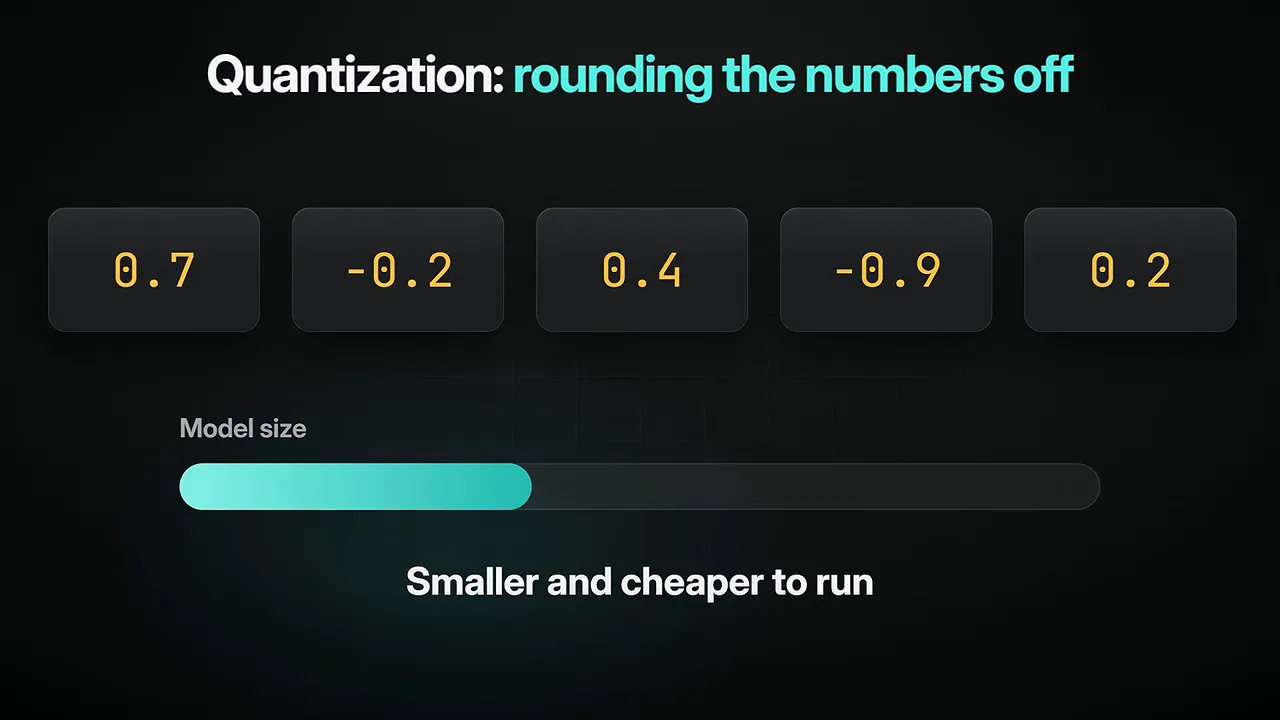
The theory is that a company launches the full-quality version, gets everyone excited, then quietly serves a cheaper quantized version later.
Honestly, if someone proved that was happening, I would not be shocked. But suspicion is not evidence. I did not find an admission, a leak, or hard proof establishing that this was the explanation.
What the independent trackers found
Independent testing gives us a more useful picture, although not a complete one.
- LiveNerf ran the same 78 questions through Opus 5.5 every day. Across its first 50 days, it did not detect a performance drop.
- MarginLab detected a Claude Code pass-rate decline from about 65% to 50%. Its investigation pointed to an application or harness update, rather than a regression in the model itself.
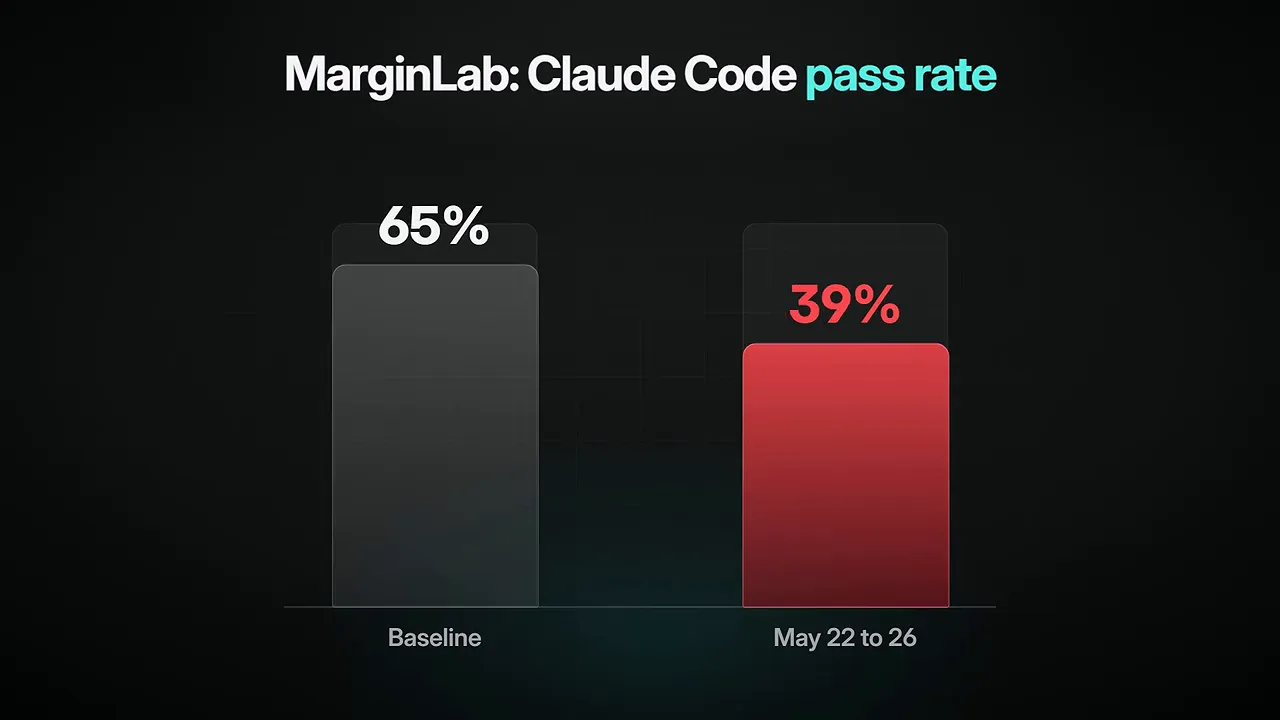
These tests measure behavior. They do not directly inspect a proprietary model's weights. And LiveNerf itself acknowledges that smaller changes can slip through.
So a stable score does not prove that absolutely nothing changed. A falling score does not, by itself, tell us which component broke.
It is also worth noticing who built these daily checks: independent people trying to answer a question the labs were not answering through equivalent public daily scores. We know less than the confident arguments online sometimes suggest.
The Four Dials That Can Make AI Feel Worse
I have experienced this myself. I've asked a model to build a game or create a picture on launch day, then repeated the same prompt with the same named model a couple of weeks later and received something noticeably worse.
That is a reason to investigate. It is not enough to identify the cause. For that, the four dials are a much better framework.
1. Effort: How Much Thinking the Model Gets
Effort controls how much work the model is allowed to do before answering. The name on the model selector can stay exactly the same while the amount of reasoning behind its responses changes.
Anthropic reduced Claude Code's default effort from high to medium to make it faster. The change was not clearly surfaced to people at the time, and Anthropic later acknowledged that it had made the wrong trade-off.
This also helps explain why a launch benchmark can look better than your everyday results. In the Opus 5.5 coding comparison, the headline score was 57.8% at maximum effort, compared with roughly 52% at the medium default.
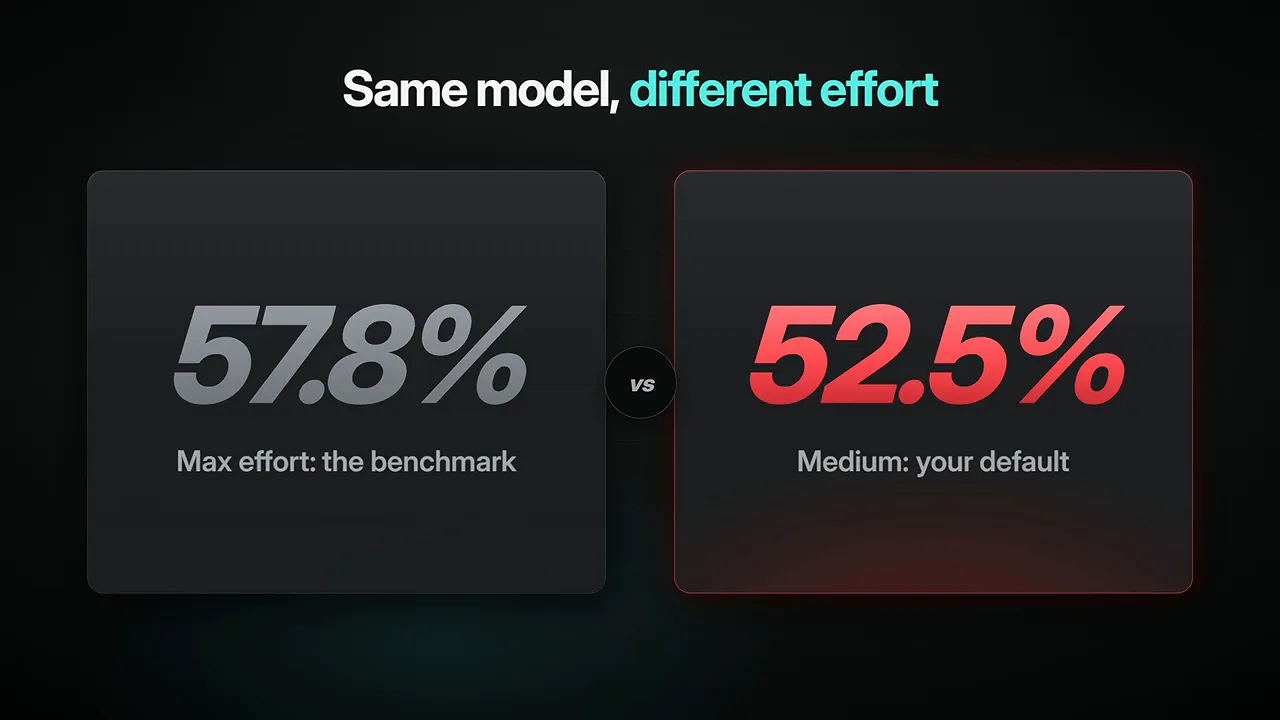
Same model, different effort budget, different performance.
So when an impressive demo or benchmark appears, the useful question is not just, “Which model did they use?” It is also, “What effort setting did they use?”
Where the product exposes that setting, you can turn it up. But maximum effort is not automatically the right choice for every task. More effort costs time and money. Too little effort can produce bad results that take even more time to fix.
The goal is enough reasoning for the task, not the highest setting for everything.
2. Instructions: What the Model Is Told to Do
Most AI applications wrap the model in instructions you do not write yourself. These are commonly called system prompts.
They live within the broader harness: the software and surrounding setup that turns a model into a usable assistant or coding agent. Your own instructions, such as a CLAUDE.md file, add another layer.
Change those instructions and you can change the results without touching the weights.
For example, Anthropic introduced an instruction telling Claude to keep the text between steps to 25 words or fewer. Its own testing found that the constraint hurt performance.
OpenAI also described an issue with Astra invoking older skills too frequently. Instead of helping the model complete the task, those skills were getting in its way.
This is why “more instructions” does not necessarily mean “better assistant.” Adding constraints, removing guidance, or activating the wrong skills can make a capable model behave poorly inside a particular application.
3. Routing: Which Model Actually Answers You
Routing decides where your request goes. The model you believe you selected is not always the model that ultimately handles the task.
That was central to the GPT-5 launch issue. It also helps explain a dramatic debugging-score drop reported after Fable 5 returned online: a benchmark fell from roughly 86 to 26.
That sounds like a model getting completely nerfed. But nine of the 12 tasks never reached Fable. A safety filter redirected them to Opus 4.8 instead.
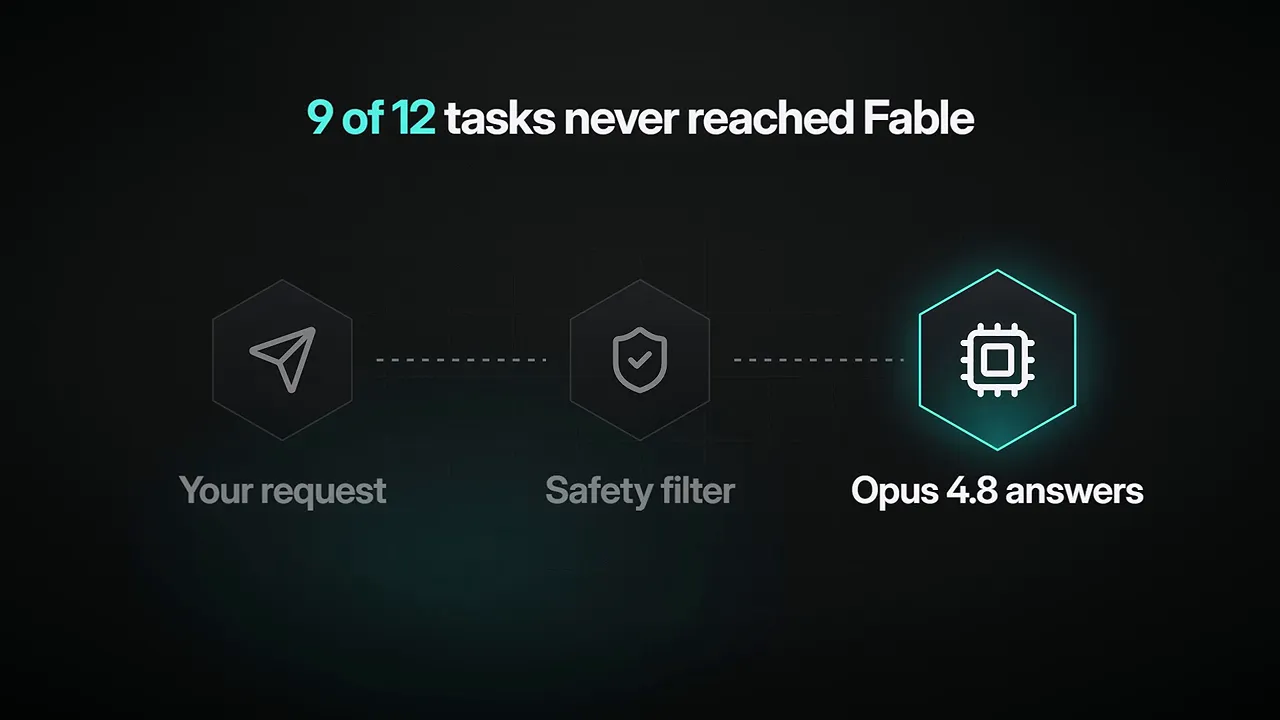
Initially, that redirection was not clearly disclosed. People could reasonably think they were evaluating Fable when much of the output was coming from an Opus model.
In my own test of 63 questions, 14 received refusals, and I also encountered the silent-routing behavior. That makes it difficult to judge the model you thought you were testing.
A score attached to a product is not necessarily a clean measurement of one model's capabilities. It can also reflect the filters and fallback decisions in front of it.
4. The App: Bugs Around an Unchanged Model
Sometimes the explanation is less mysterious: the software is broken.
Anthropic shipped a bug that cleared Claude's thinking on every turn. From the user's side, that could feel like the assistant kept forgetting what it was doing. The model's weights did not need to change for the experience to get substantially worse.
OpenAI also identified misconfigured servers that degraded Astra's performance for part of its traffic.
That last detail is important. A problem can affect only some requests, which helps explain why one person insists everything is fine while another is having a terrible time.
Lower effort, restrictive instructions, unexpected routing, and application bugs can all produce the feeling of a weaker model. The degradation is real. The cause may be outside the model itself.
Why Compute Makes Me Suspicious
Every token costs real money and uses real GPU capacity. Compute is not an abstract concern for these companies. It is a resource they have to manage while competing aggressively for adoption.
A major launch makes that harder. After GPT-5 launched, Altman said API traffic had roughly doubled within 24 hours. That's a huge increase in demand for infrastructure that already costs money to operate.
Reducing reasoning effort is one way to make responses faster and reduce the work required per request. We have an acknowledged example of that trade-off happening.
Here is where I separate the evidence from my opinion.
My suspicion is that the launch cycle creates an incentive to put the strongest possible experience front and center, generate impressive demos, win subscriptions, and then look for efficiencies once adoption arrives. Launches get polished promotional material, early creator access, and a flood of attention. I'm still waiting for my early access, by the way.
But an incentive is not proof of a coordinated bait-and-switch. The documented effort reduction makes the concern reasonable to investigate. It does not establish that every disappointing answer is a deliberate cost-cutting decision.
There are confirmed regressions, acknowledged speed-versus-quality trade-offs, and ordinary bugs. Those should not all be collapsed into the same accusation.
Could Some of It Be in Our Heads?
Yes. That does not cancel out the real problems.
Imagine a model gives a bad answer once every 20 prompts. By your hundredth prompt, you have encountered several failures. If the launch hype made it sound like near-perfect intelligence, those failures are going to stick in your memory.
You remember the moment it missed something obvious, not all the routine tasks it handled correctly.
The work also changes. During launch week, people experiment with flashy games, pictures, and impressive standalone prompts. Later, they bring the model their actual work: difficult tasks requiring extensive context, earlier reasoning, and domain expertise.
That is not necessarily an apples-to-apples comparison.
Both things can be true: the product may have genuinely degraded, and your later tasks may be harder than the ones that shaped your first impression.
The Bigger Problem Is Transparency
People pay $20, $100, or sometimes $200 a month for these tools. Yet the provider can change the effort budget, the surrounding instructions, the routing, or the application behavior without an obvious notice explaining how the experience has changed.
In my research, I did not find a specific requirement forcing providers to disclose every adjustment to those quality-related settings. That is a narrower claim than saying no law could ever apply.
The closest measure I found was Connecticut legislation requiring usage-limit disclosures before signup or renewal. Disclosing how much someone can use a service is not the same as disclosing whether the quality of that service has declined.
My position is simple: if I am paying for a service and you materially change what I receive, you should tell me. That is the transparency standard I think customers deserve.
What to Check Before Calling a Model Nerfed
Until disclosure improves, independent testing and your own comparisons matter. The four dials give you somewhere more useful to start than assuming the model's brain was secretly swapped.
- Check effort settings. Make sure your everyday configuration matches the effort level behind the benchmark or demo you are comparing against.
- Inspect the instruction layers you control. Your project instructions and skills are part of the environment, not separate from its performance.
- Look for routing or fallback behavior. Where the product provides that information, check which model actually handled the request.
- Separate app changes from model changes. A harness update, context-handling bug, or server issue can hurt results without changing the weights.
- Use repeated comparisons. A fixed set of questions is more informative than one frustrating answer, although no small benchmark catches everything.
The strongest conclusion is not that every AI company secretly replaces its launch model with a cheaper brain. I could not prove that.
It is that an unchanged model can deliver a worse product when the systems around it change. We have acknowledged examples of that happening. So if Claude or GPT suddenly feels less capable, don't dismiss the experience, but don't stop at the label “nerfed” either. Check what changed around the model.


