Anthropic’s enormous public debut comes with a number that is almost harder to get your head around than its valuation: about $900 billion in spending commitments, mostly for computing power.
After its first trading day, the company was worth roughly $1.8 trillion. Its actual debt, meanwhile, was only about $6 billion. And yes, calling $6 billion “only” anything feels ridiculous. But the distinction matters, because debt and promises to spend money in the future are not the same thing.
That distinction explains a lot about this IPO, the risks running through the AI industry, and what could happen to Claude next. If you pay for Claude, you are already part of the business that investors are betting on, whether you ever buy a share or not.
Key Takeaways
- Anthropic’s $900 billion bet consists mainly of future computing commitments, not existing debt.
- Interconnected investments and infrastructure purchases can amplify both AI growth and an industry slowdown.
- Claude could become more capable without a corresponding relaxation of usage limits.
- Building practical AI skills may offer more personal value than buying shares in one company.
What Happened in Anthropic’s First Two Trading Days?
An initial public offering, or IPO, is when a private company starts selling ownership shares to the public. Anthropic’s offering made it the first standalone AI lab to go public, with OpenAI having also filed but not expected to list until the following year.
The scale was historic:
- IPO price: $83 per share.
- Money raised: About $81 billion, the largest IPO fundraising total.
- Opening trading price: $111.50 on Thursday.
- First-day valuation: Roughly $1.8 trillion, making Anthropic the seventh most valuable company in America.
Then Friday happened. The broader AI trade sold off, and Anthropic briefly traded only about $5 above its IPO price before closing around $88.
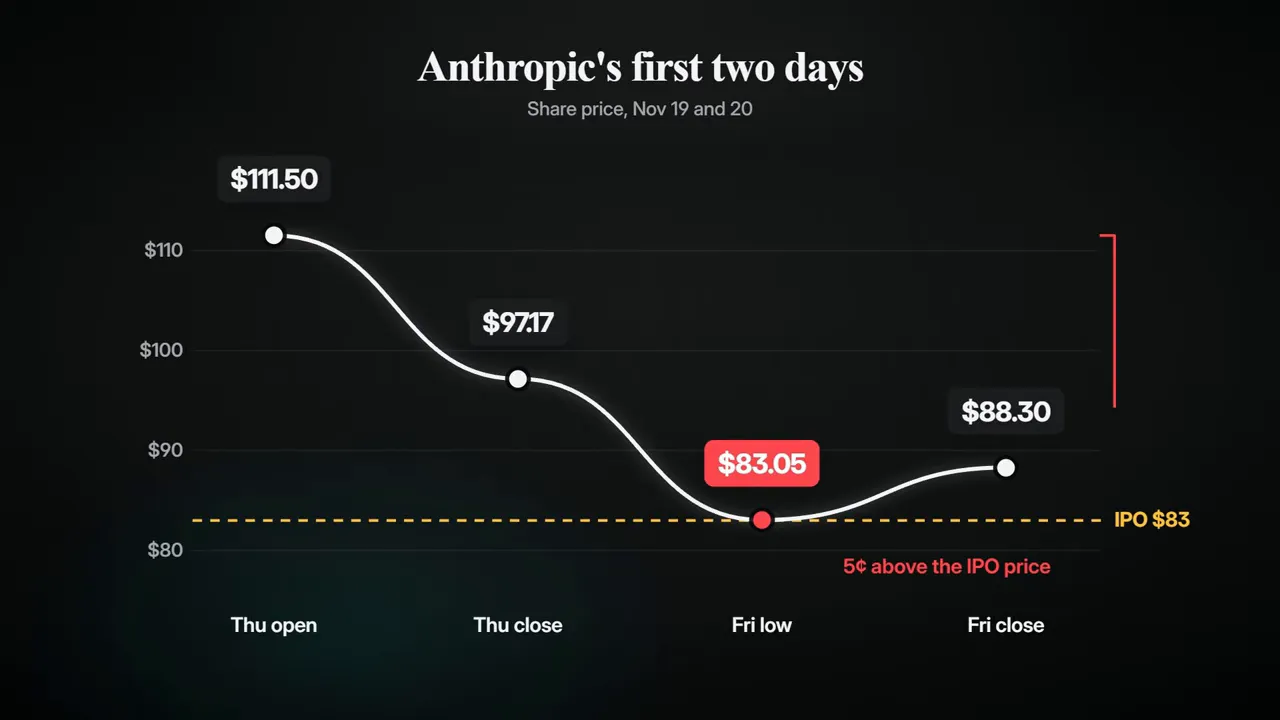
If you bought at Thursday’s opening price, rather than receiving shares at the $83 offering price, you were already down about 20% by Friday’s close.
That is an important difference. A successful IPO for the company does not automatically mean a successful investment for someone buying after trading begins.
Your Claude Subscription Is Part of the Investment Case
Going public requires a company to publish a prospectus, a detailed document explaining its business, finances, governance, and risks. One of the most useful things in Anthropic’s filing is the breakdown of where its revenue comes from.
About 11,900 large customers account for roughly three quarters of revenue. The remaining quarter comes from around 40 million customers who each spend less than $100,000 a year on Claude.
That second group includes individual subscribers, smaller businesses, and people paying for API access. So when your Claude subscription renews, that payment contributes to the revenue stream Wall Street is now pricing.
Does that mean going public immediately changes your plan? No. The listing itself did not change the models or subscription terms.
It also did not hand outside shareholders unrestricted control. The founders retained control through a special share carrying 50.1% of the votes, while a mission-focused trust elects most of the board.
That structure matters. Public-market investors cannot simply walk in and dictate that Claude users should be squeezed for every possible dollar. It does not eliminate commercial pressure, but public ownership and control are two different things.
Why AI Spending Matters Beyond Claude
The bigger economic story is not just how many people subscribe to an AI assistant. It is how much spending the AI buildout is driving.
GDP measures the total value of what a country produces. In the first half of the previous year, computer equipment and software represented only about 4% of the U.S. economy, but accounted for roughly 92% of its growth.
That is a wild imbalance. A relatively small part of the economy was responsible for almost all its growth during that period. AI-related spending was doing a lot of the heavy lifting.
It also means a slowdown in that spending would matter well beyond one chatbot, one stock, or one data center.
The Circular Financing Loop
A lot of money in the AI industry moves through interconnected relationships. A company invests in an AI lab, the lab spends money on that company’s infrastructure, and the same companies may also buy the lab’s products.
That is the basic idea behind circular financing. The relationships are easier to understand through a few examples:
- Nvidia and OpenAI: Nvidia announced plans to invest up to $100 billion in OpenAI, which would use funding to buy Nvidia chips.
- Amazon, Google, and Anthropic: Amazon and Google own substantial stakes in Anthropic, sell it computing capacity, and also buy Claude.
- Broadcom and Anthropic: Broadcom leases chips to Anthropic and agreed to lend it up to $42 billion to help fund those payments.
- Additional stock purchases: Alongside the IPO, seven chip and cloud companies, including Nvidia, bought another $26 billion of Anthropic stock.
You can see the pattern. These companies are not making separate, unrelated bets. Their investments, infrastructure sales, and product purchases are tied together.
As long as demand keeps growing, the loop can reinforce itself. More investment funds more computing capacity, which supports more AI usage, which helps justify more investment.
But if demand slows, that same interconnectedness can work in reverse. Several companies can feel the pressure at once.
How $900 Billion in Commitments Differs From $6 Billion in Debt
Anthropic was not entering its IPO buried under $900 billion of conventional borrowing. It had about $6 billion in actual debt and more than $130 billion in cash and investments before the offering.
The huge number is its future spending commitments: roughly $900 billion, almost entirely related to computing power. About $70.7 billion was due within the following 12 months.
Think of it like signing a 20-year lease on a giant building because you are convinced your business will grow into it.
If the business grows as expected, securing that space in advance could be a great decision. You have the capacity you need, and the commitment may prove economical. If the business does not grow into it, the same lease becomes a serious problem.
That is the core of Anthropic’s bet. The company is committing to infrastructure today on the expectation that future demand will justify it.
I think continued growth in AI demand is a reasonable bet. But reasonable is not the same as guaranteed, especially at this scale.
The market turbulence offered a reminder of how connected these bets have become. Nvidia’s reported leadership upheaval, including Jensen Huang’s resignation and uncertainty around a possible return, added to a period in which its shares had fallen about 46% over seven weeks. When Nvidia fell sharply on Friday, Anthropic fell with it.
Owning shares in an AI lab does not necessarily isolate you from the risks facing the chip companies and cloud providers supporting it.
Four Things That Could Happen Next
Nobody can confidently tell you exactly where this goes. But Anthropic’s filing points toward four developments worth paying attention to.
1. Claude Gets Better, but Usage Limits Stay Tight
Anthropic says demand keeps exceeding the computing capacity it arranged in advance. To fill the gap, it has been buying more expensive short-term capacity and expects to buy more.
That helps explain why a company can commit enormous amounts to infrastructure while users still encounter limits. Future capacity commitments do not mean all that capacity is available right now.
My expectation is that Claude keeps improving and the cost of completing a task comes down. But I would not assume usage allowances suddenly become much more generous. Better models and tight limits can exist at the same time.
2. Anthropic Builds More Apps and Competes With More Customers
The filing acknowledges that Anthropic already competes with some of its customers and may increasingly do so.
That is a big deal for software companies building products around its models. The same company supplying their AI capabilities can also move into their market with a product of its own.
Some launches have already coincided with sharp stock moves:
- Thomson Reuters fell about 16% after a legal plugin launch.
- CrowdStrike fell about 11% after Claude Code Security.
- Figma fell about 7% on the day Claude Design launched.
Those moves show how sensitive investors are to the possibility of AI labs expanding into established software categories.
Anthropic also has roughly $100 billion in fresh funding from the offering and related investment. Its filing says money could go toward acquisitions, so expansion does not have to come entirely from building products internally.
3. Claude Moves From Chatbot to Coworker
The filing describes “virtual collaborators,” meaning agents that operate inside a company’s tools rather than simply answering questions in a chat window.
The ambition is to reach knowledge workers broadly, a population Anthropic estimates will exceed one billion people by 2028.
That is a different product vision from a chatbot you open occasionally. It is Claude becoming part of everyday workflows, connected to the tools and information people already use to do their jobs.
That direction does not feel far-fetched to me. It is also why understanding how to use these systems matters more than memorizing the latest model announcement.
4. Revenue Growth Slows and the Stock Stays Volatile
Anthropic’s quarterly revenue grew more than 1,000% year over year. That is extraordinary, but no company can sustain that rate indefinitely.
The filing explicitly warns that the revenue growth rate is expected to decline over time. That does not necessarily mean revenue falls. It means the percentage increase gets smaller as the business becomes larger.
Add the prospect of early investors becoming eligible to sell around May, plus a stock that is already moving alongside Nvidia, and I would expect more rough weeks.
A company can keep growing while its shares remain uncomfortable to own. Those are not contradictory outcomes.
Should You Buy Anthropic Stock?
I am not a financial adviser. I have a computer and an internet connection, and this is not financial advice.
But there is some useful historical context. University of Florida researcher Jay Ritter has tracked U.S. IPOs going back to 1980. On average, buying at the end of the first trading day and holding for three years has meant trailing the broader market by about 20 percentage points.
That is not a prediction for Anthropic. Large companies with substantial revenue have generally done better than that average, and Anthropic is growing faster than almost anything in the historical data.
So this is genuinely a difficult call. The business is remarkable. The commitments are enormous. The stock price already reflects substantial expectations.
My practical rule is simple: do not buy something you would panic-sell after a week like this one.
The Best Return May Be Learning to Use the Technology
If you pay for Claude, you already contribute to the customer revenue supporting this business. You do not need to own the stock to have an economic relationship with Anthropic.
I run pretty much my whole business using tools like Claude Code, working out of one folder. In that setup, the subscription is the cheap part. The real value comes from knowing how to use the tools well.
For most people, that may be the more useful investment: getting genuinely good at using AI models, understanding the technology, and applying it to valuable work.
You cannot control Anthropic’s valuation, the next market selloff, or whether its infrastructure commitments work out exactly as planned. You can build skills that make the technology more useful to you. That is a bet on your own capabilities, rather than just one company.


